


1.
You’ve heard this one. King Minos of Crete had a half-bull, half-man hidden in an elaborate labyrinth, and demanded human sacrifices to it as tribute from the other powers in Ancient Greece. We call the actual ancient civilization on Crete the “Minoans” because this is the story told about it.
There’ve been a lot of cool rewrites of the minotaur story, addressing elements different authors were unsatisfied by. Many of them introduce more compassion for the imprisoned creature, or more agency for Ariadne, the minotaur’s human sister. The Hunger Games explores an incompleteness of the ending from a modern perspective—in the ancient myth, the minotaur is slain, but the tyrant remains in power, when surely King Minos is the real enemy.
We rarely tell the story the way the people of Ancient Crete would’ve wanted us to. We treat the myths invented by their enemies as the baseline to adapt. But surely they deserve a say. Nobody’s decoded their language yet, but their art and architecture does tell a story.
2.
Here is Crete in its own paintings and pottery.
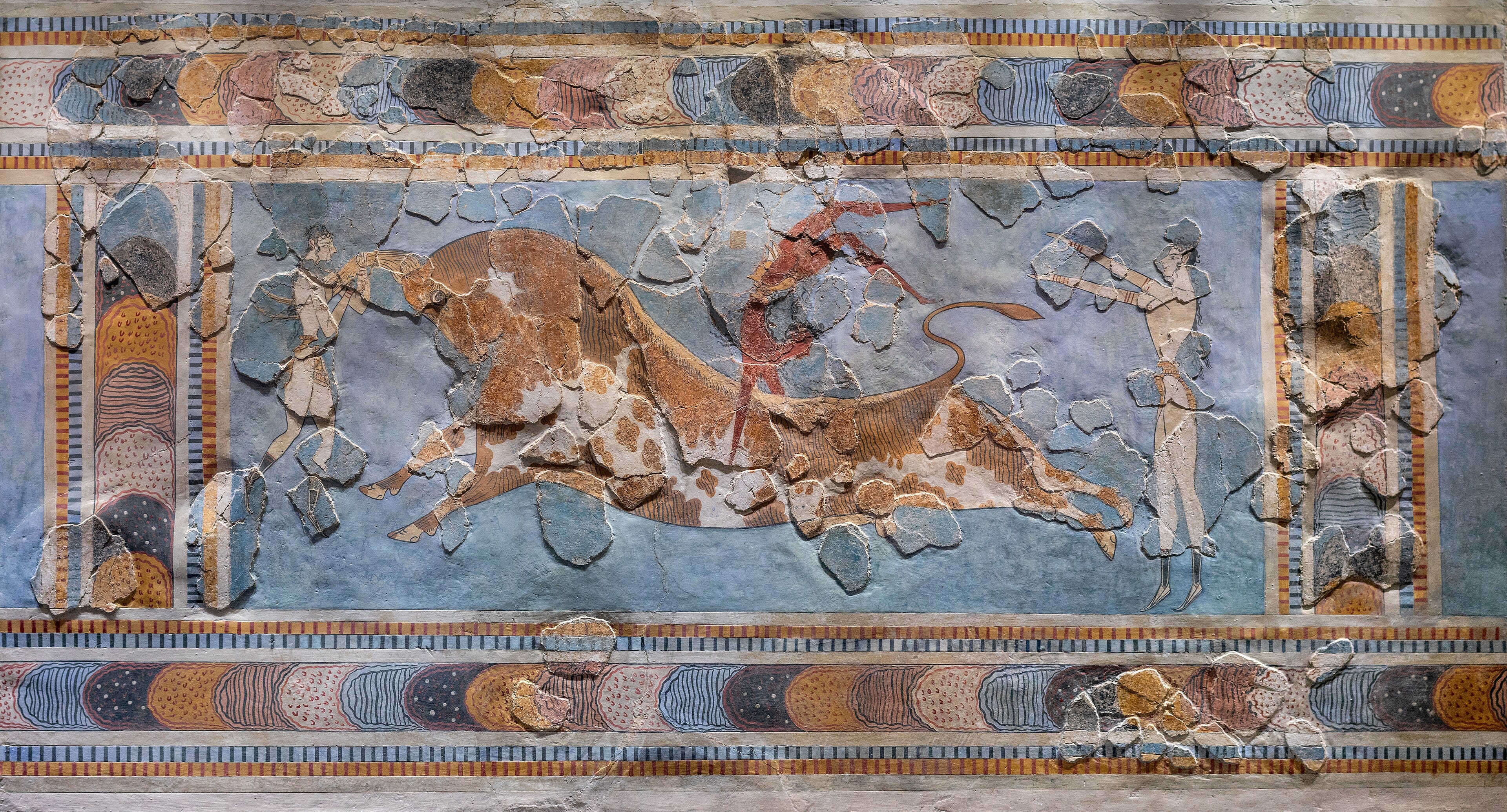
There is very little violence. There’s bull-fighting, but not to the death—the unarmed human leaps over the charging bull. They box wearing boxing gloves. Sports are about skill and bravado, not blood.
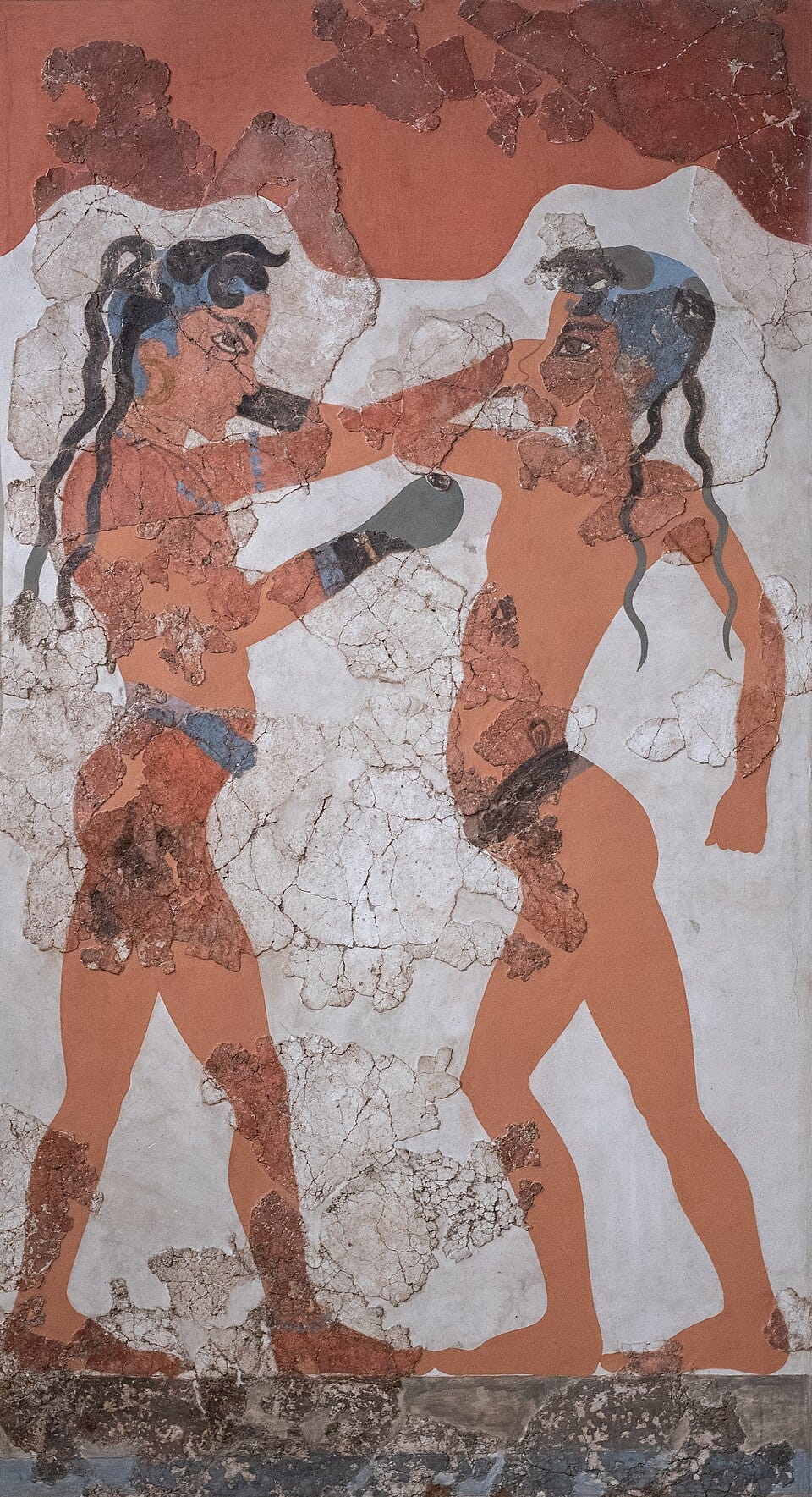
Nudity and pregnancy are taboo. Even the athletes wear loincloths. Adult men and women wear restrictive clothing to give themselves hourglass figures.
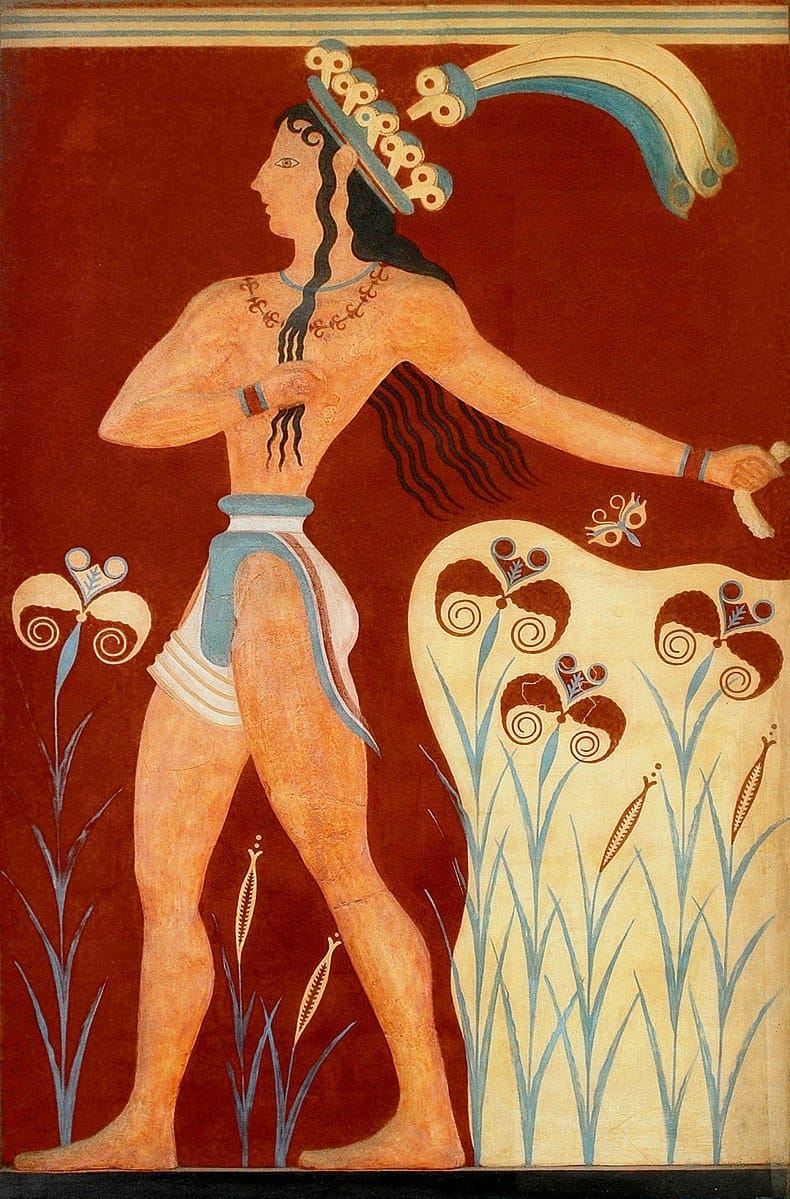
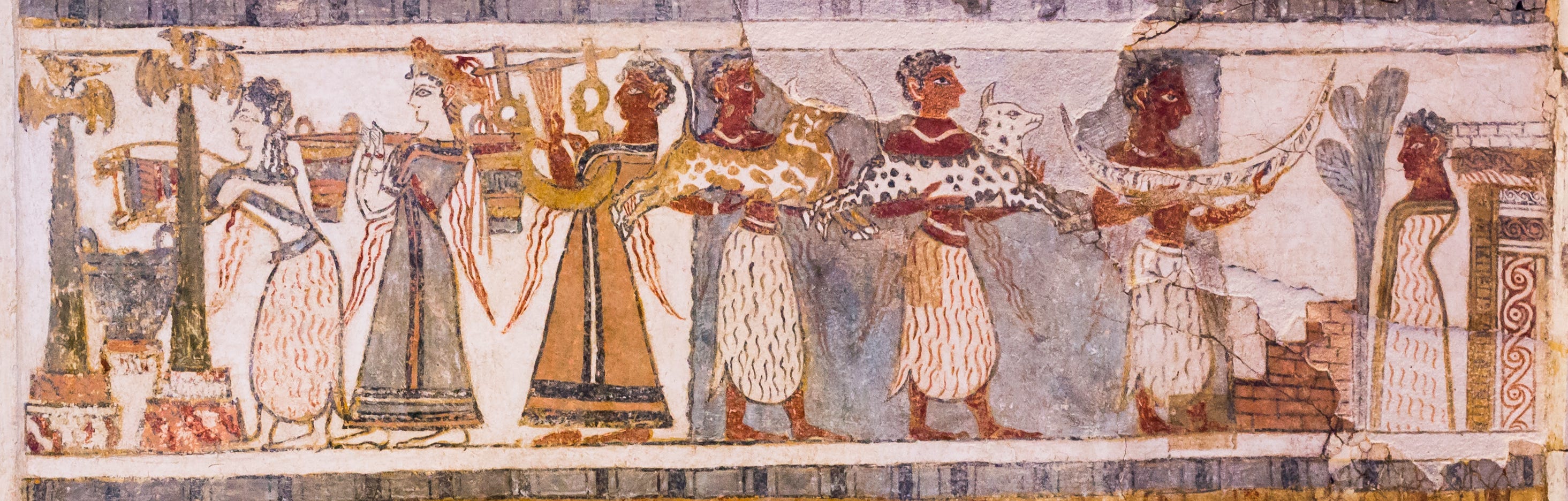
There are no kings. No royalty. Some people are dressed fancier than others, but nobody’s kneeling to them or anything. Religious ceremonies can involve men, but are always led by women. Otherwise the gender roles seem similar to Western tradition.
3.
Here is Crete in archaeology.
A few defensive structures, but no clear evidence of warfare. Certainly no evidence of dominance over other Greek powers. A few functional-looking swords, but mostly just ceremonial daggers and jewelry. No mass graves of people who died violently. The taboos surrounding pregnancy, however, have serious consequences. The childbirth death rate seems to have been high, even by the standards of ancient cultures.
Most of their engineering work goes into public infrastructure. They have sewers, aqueducts, water filtration systems. Even though there’s good fishing, they put some serious effort into agriculture, including domesticating bees. They export luxury goods as well as food. They import, mainly, raw metals, so that they can make more stuff.
They build large, elaborate malls, with workshops, shrines, and storage areas, and a central rectangle courtyard. They try to align them with the surrounding landscape, in shape and material, so each one looks different. They renovate and remodel them often, adding more and more rooms until they start to become, yes, pretty maze-like.
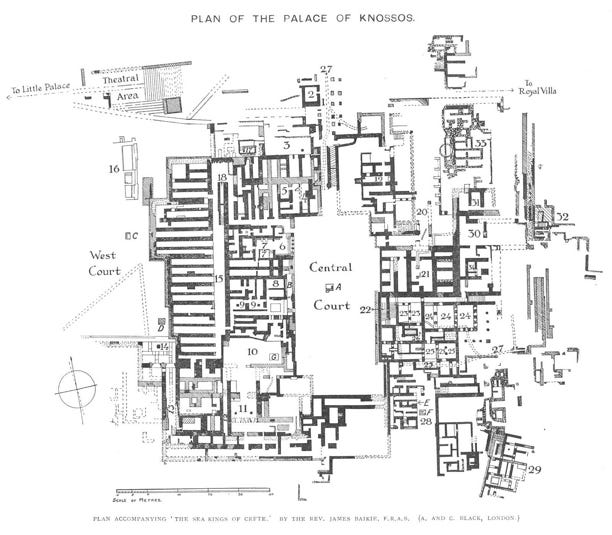
They have no central currency, no palaces, no thrones. People call the malls “palaces,” sometimes, and their environs “royal villas,” but the evidence doesn’t support that.
4.
So here is how, as best I can tell, Ancient Crete would want their story told.
We are brave, clever, and strong, but we always come in peace. We’ll trade you food, if you need food, or jewelry, for whatever comes out of your mines. If you’re curious what we do with your ore, send a lucky few of your youths to our main island every so often. They’ll get lost in one of our mazes of stores, and eventually find their way to the open space at the center, where the day’s entertainment can be found—a play, a martial arts tournament, or a bull-leaping show. We don’t recommend that tourists participate in that last one, but be warned: we do allow them to if they volunteer, so choose carefully whom you send.
Leaders? Well, most people tend to respect the opinions of the high priestesses, but their word is only law in matters of ritual. Our politics are as complex and changeable as our labyrinths, so best not seek to understand them. One thing you may be sure of, though—if a great mass of people work together to build something, that something is for the people as a whole, not one of your “palaces” built for one man and his family.
5.
What was the reality?
If the “Minoans” didn’t depict something in their art, it might have not existed, or it might have been taboo. Nobody is shown giving birth, but plenty are shown raising children. Could be they had wars and bloodsports, but it was taboo to depict them. Could be they had royalty of some kind, forbidden from images. Could be they had royalty, overthrew them, then destroyed all the evidence that they ever existed. Could be the tyrannical and secretive King Minos of myth was real, and chose to blot himself out of history.
Or maybe everything was exactly the way it looks—a well-functioning, technologically advanced anarchist society, lightly matriarchal, which lived in peace for about six hundred years before the Mycenaean Greeks on the mainland conquered them. That’s the story that suits my own agenda; a good fit for my political propaganda. That’s roughly the story it looks like they probably told about themselves, so I feel okay about choosing to believe it.
6.
Others turn the labyrinth into a prison.
In mainland Greek myth, the legendary engineer Daedalus lives in Crete. He invents indoor plumbing, yes, but also coastal defense robots and the unescapable labyrinth, all at the command of King Minos. After the minotaur dies, Minos imprisons Daedalus himself, and his son Icarus, in the very labyrinth they made. So they invent artificial wings for themselves, and fly away. Daedalus escapes, but Icarus, in his hubris, flies too high, too close to the sun, causing the wax joints of his wings to melt, and plummets to his doom.
The Cretans were the dominant traders in the region. For six hundred years, a Cretan ship on the horizon meant more was about to be possible, that exotic goods and a time of plenty were arriving. Perhaps that felt like a threat to the powers that were, who stayed in control with a promise of security amid scarcity. So, in myth, they turned the merchant ships into a conquering fleet.

More is possible, the myths say, but there are limits. There will always be tyrants and war; it’s folly to think otherwise. Fear Crete for their power; don’t envy them for their wealth and freedom. Perhaps we can fly, but not too high.
If the Minoans themselves had a legend of Icarus, I doubt they made it a lesson against youthful hubris. The youth in their frescoes, after all, are jumping over charging bulls. If Icarus dared to fly higher than his father, more honor to him. And as we retell the legend of Icarus today, I think we could stand to mention more that the atmosphere does not work that way. As you get closer to the sun, the air thins, trapping and conducting less heat, not more. If you can solve all the other problems, you can fly as high as you like. In 2023, American statistician Aaron Smith set the record by jumping out of a plane in a wingsuit at a height 4 and a half times higher than the peak of Mount Olympus.
(If using an airplane seems like cheating, you might prefer a video of Russian extreme sports star Valery Rozov flying from Mt. Everest. Sponsored, because some things never change, by Red Bull.)
I’m endlessly fascinated by historical fact and by science fiction, and I think it’s mainly because both can help us to remember just how free we are, by showing us very different societies made up of the same building blocks as ours. We miss that opportunity when we project too much onto them. We can imagine a society ruled by high priestesses, but shy away from imagining a society that isn’t ruled by anyone. We look at artwork where some people are wearing fancy clothing and jewelry, and some people are wearing simpler outfits, and say “Ah. The Minoans had a socioeconomic class hierarchy.” Not, say, “the Minoans had different kinds of clothing for different occasions.” Not “the Minoans had a bimonthly lottery that determined who got to wear jewelry and take a vacation.” Not “the Minoans had people who got to wear fancy clothing, and people who got better housing, and people who got their first pick of the food, and people who got more elaborate burials, but you had to pick one and only one of those four.”
Look around at the artifacts of our society. What stories should we choose to tell with these raw materials? The present is archaeology. The future is how we interpret it.