


This is a review-ish of The Odyssey (2026). As such, it may spoil aspects of the adaptation that were meant to be surprising.
1. Cunning Odysseus
Nolan’s Odysseus is wilier than Homer’s. I’ve seen quite a few reviews that get this backwards. I think they were expecting a more Hollywood flavor of cunning, maybe the one where Odysseus would make a series of seemingly random moves that all turn out to be part of a master plan, explained in voiceover. Instead, we generally watch Matt Damon silently think through his next few moves, wincing as he comes to the inevitable sacrifices.
The key difference here is Nolan’s lack of unambiguous gods. They make their presences felt, but only Athena speaks, and she never conclusively proves that she exists outside of Odysseus’s imagination. This means that Odysseus has to be the one to actually figure out what’s going on and what to do.
It’s starkest in the Circe encounter. Nolan’s Odysseus is the Final Girl protagonist in a horror story, figuring out the terrible truth, narrowly outwitting Circe, and then somehow managing to make peace with her. In Homer, the god Hermes just shows up and blurts out the whole situation ahead of time. Hermes also gives Odysseus the antidote1 to Circe’s spells and step-by-step instructions on how to seduce her.
In Homer’s idiom, I think the audience might understand Hermes to be, simultaneously, a literal being and a metaphor for Odysseus’s own mental powers, the way in real life they’d say someone observed to be a smooth talker “must be blessed by Hermes.” That’s not how we moderns tend to think, though, so Hermes manifesting and just…tweeting it out…would have (literally) spoiled the plot.
Telemachus gets a similar upgrade. From a modern perspective, there’s a certain hollowness to his coming-of-age story in Homer. He’s performing adulthood, but only by following detailed instructions from Athena every step of the way and using his royal privilege to avoid danger and hardship. It doesn’t really feel like he’s left the nest. Nolan’s Telemachus, even though he thinks everybody is secretly Athena, makes up his own mind, acts on his own initiative, and finds his strength.
Most screen adaptations of the Odyssey make similar changes, but quietly, without calling attention. Nolan rips the gods out of the story, leaving a gaping wound, forcing the protagonists to struggle with their faiths as they muddle on through.
I still missed the “My name is Nobody” trick, which Nolan says he couldn’t quite make work. It seems to have snuck in anyway, though. We’re told early on that “no one knows” who the people from the sea are. As we learn at the end, No One does, indeed, know.
2. God As Stranger
I’m biased towards loving this movie because of the way it centers sacred hospitality. The phrase “god as stranger,” theoxenia in Greek, represents some deep wisdom that we ignore at our peril. I’ve already written an article with that title making that argument, so I won’t repeat myself here.
One of the funnier scenes in the New Testament appears in Acts 14. Paul is traveling far and wide, speaking eloquently and persuasively, and occasionally performing miraculous healings. So some people come to the obvious conclusion: he’s secretly Hermes in disguise, here to test their fidelity to the gods. In Lystra (a city near Konya in what is now Turkey), after he’s seen healing someone, the locals start arranging to sacrifice a bull to him. Paul and his co-apostle, who the crowd decides is Zeus, frantically try to persuade them that they’re mortal, eventually tearing their clothes off and rushing into the crowd going “See! Normal human body!” That’s when the cops show up.
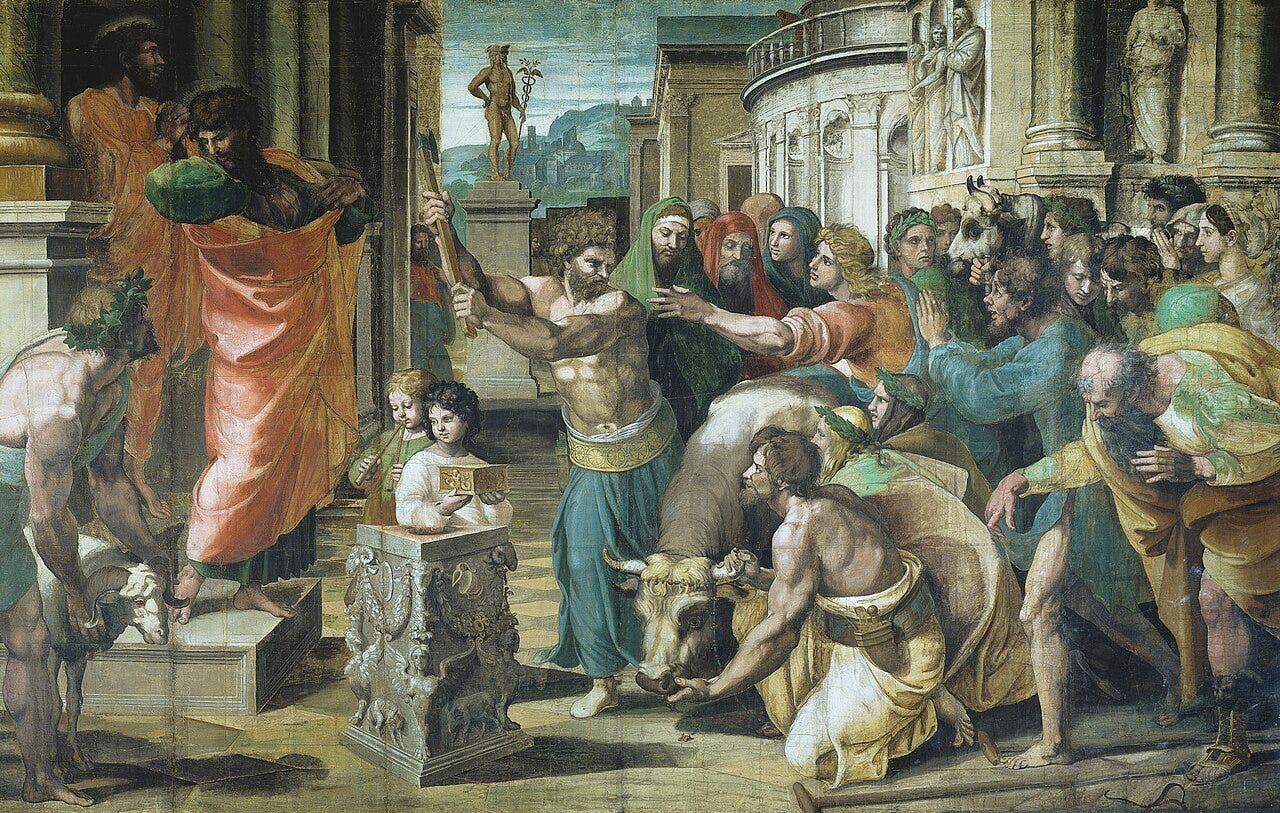
The Book of Acts helps demonstrate that the promise at the end of Nolan’s Odyssey, that civilization would rise again, had come true by Paul’s time. Paul was able to travel so far, and convert so many, because hospitality towards weird heretical strangers was sacred, and because, when arrested, he could invoke his rights as a Roman citizen. The Roman poet Virgil, in fact, had recently written an unauthorized fan sequel to the Odyssey, the Aeneid, which follows Trojan refugees as they keep the flame of civilization alive, and ultimately rekindle it in Rome. Nolan’s Odyssey signals from very early on that it’s drawing on the Aeneid: Elliot Page’s character is from that book, not Homer’s.
3. There’s No Such Thing As Antipolitical
I mostly avoided “spoilers,” including casting spoilers, for this movie. When I saw Lupita Nyong’o as Helen and Clytemnestra, though, it was all too easy to infer the tired old back-and-forth over racial casting that I’d dodged. I won’t go into it too much on the object level. I’ll just note that since Helen is the daughter of Zeus and a swan, the laws of genetics clearly dictate that she must have looked like a storm cloud with feathers and a thin curvy neck. And a very pretty face, of course.2
On the meta level, this kind of “anti-woke” reaction annoys me because it presents itself as trying to purge politics from somewhere it doesn’t belong. It lacks the self-awareness to realize that it is being political. Art is inherently ideological, and when you critique ideology you are being political.
You know what, I don’t even really want to get into it on the meta level. It’s all been said and said and said.
4. Yes this is a very good movie
Homer’s poem starts by asking his Muse to help him adapt this ancient story for modern times. I think that Muse is still singing.
A mythical (?) kind of plant named “moly,” which when delivered by a god would make it “holy moly.” I went to the Wikipedia page for the term “holy moly” and it said “No, Aaron, that was not the origin of this phrase. We knew you’d look this up eventually.”
Also the only valid criticism of Elliot Page’s casting is that he didn’t play Tiresias, who canonically is a man who once spent many years trapped in the body of a woman.