


I wrote recently about a New York Times editorial that argued that it was practically impossible to invent an airplane, just a few weeks before the invention of the airplane. In their defense, up to that point, every demonstration of heavier-than-air flight had either failed or turned out to be a hoax. “Flying machines can’t actually fly” was a heuristic with a perfect record.
The Wrights had their first successful test flight, on December 17th, 1903, and immediately alerted the media. So the New York Times, of course…
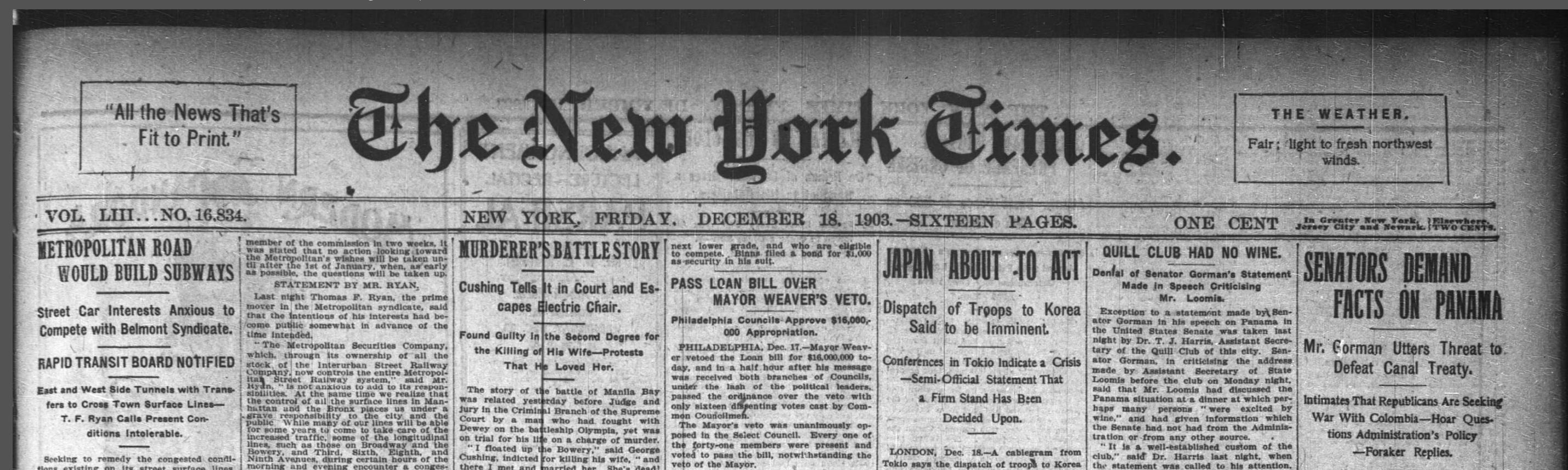
ignored them for the next five years.
The Times was in good company. News coverage of the Wright Flyer was sparse. Outside of Ohio, close to non-existent. The invention of an airplane would be a huge deal, editors reasoned. World-changing. Since there aren’t any news reports on it, it must not be real. Flawless logic, except when everybody executes it in lockstep.
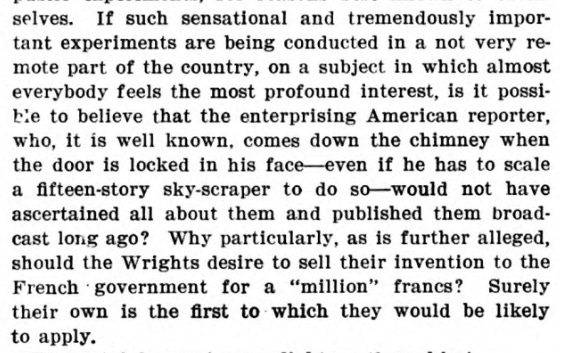
As Scientific American noted, surely the U.S. government would have snapped this invention up if it were real. True, except that the Wrights had tried to sell to the U.S., and the government ignored them, presumably reasoning that if they were for real, Scientific American would have covered them already.
Meanwhile, people driving near Dayton, Ohio kept looking up and seeing machines flying around in the sky. They’d report this to the Dayton Daily News, but the news staff found it too unbelievable to be worth investigating, without more evidence. They were annoyed by how often they had to keep telling people that.
The Wrights found the situation funny, and mostly convenient—they didn’t need publicity quite yet, and there were advantages to operating in stealth mode. They hadn’t really thought it would be possible to hide what they were doing, once it started working. But it turned out their airplane was invisible to all but the pure of heart.
For five years, if you wanted to read any solid reporting on the airplane, there was only one place to turn: Bee Culture Magazine, a trade periodical for beekeepers. Originally titled Novice's Gleanings in Bee Culture, the magazine was still being edited by its 1873 founder, an Ohio-based entrepreneur named Amos Ives Root. He ran a successful business, the A. I. Root Company, which sold beekeeping equipment. These days, he mostly left the business part to his sons, so he could focus on the magazine.
Root was obsessively curious about a great many things, one of which was advances in vehicular technology. He’d been an early adopter of the bicycle and the automobile. Some brief, sketchy references in various Ohio papers were enough to get him excited about the Wrights. He was, as they say, an “eccentric,” meaning that he didn’t see any contradiction in reading a small article below the fold in a local paper and deciding that this was the most important thing going on in the whole world.
In 1904, Root drove his nifty automobile to a pasture outside Dayton, where he was lucky enough to witness the first successful round-trip airplane flight (circling the pasture). The Wrights asked him to embargo the story for the rest of the year, which he reluctantly did, in exchange for more visits and photos.
Root submitted his writeup to Scientific American, but they of course rejected it on the grounds that if the story were real, why hadn’t anybody written about it? So Root fell back on the one publication over which he had editorial control. On January 1st, 1905, subscribers to Bee Culture Magazine were the first to read high-quality, first-hand reporting on the machine that was about to change everything. His article, an installment of his regular series “Our Homes,” had very little bee content, but a great deal of enthusiasm.

Dear friends, I have a wonderful story to tell you ― a story that, in some respects, out-rivals the Arabian Nights fables ― a story, too, with a moral that I think many of the younger ones need, and perhaps some of the older ones too if they will heed it. God in his great mercy has permitted me to be, at least somewhat, instrumental in ushering in and introducing to the great wide world an invention that may outrank the electric cars, the automobiles, and all other methods of travel, and one which may fairly take a place beside the telephone and wireless telegraphy. Am I claiming a good deal? Well, I will tell my story, and you shall be the judge.
In my judgment, he was the only writer who’d gotten it right.
Root’s enthusiasm didn’t blind him to the danger. He wrote that he approved of how slowly and carefully the Wrights were working—that was part of his promised moral of the story. In his first follow-up article, he was quite possibly the first in print to call for a law against operating a motor vehicle while intoxicated:
No drinking man should ever be allowed to undertake to run a flying-machine.
Amen to that.
Our media landscape today is bigger, more diverse, more complicated. But some streams of it are still vulnerable to the same fallacy. It can’t possibly be true that we have less than a year to regulate recursive self improvement before it can create a practical superhuman intelligence. If we were facing that kind of emergency, surely it would be front page news.
But I’m here to tell you, in this random history blog with literally hundreds of subscribers, that we are currently racing towards creating a god with effectively random values, and industry insiders think we may be only months away. We can stop this with international treaties agreeing to regulations designed to slow down the research, to force caution. If we don’t, airplanes falling out of the sky will be the least of our problems.
Am I claiming a good deal? You shall be the judge.
Terrific post, Aaron Zinger. Right up there with the admirable reporting by Amos Ives Root. I teach at Columbia Journalism School and plan to share this essay with colleagues. I know they will chuckle through it, darkly.