


It’s August 26th, 1821. Robert Waithman is on the causeway at the southern border of Hyde Park, London. He has just ordered his horse to “plunge,” a kind of crouching lunge that horses use to shake off unwanted human attention. Most riders train them out of that, of course. Not Waithman. He needs his horses to break free on command, for moments just like this one. Two men have grabbed his horse’s bridle, one on each side, and are trying to tug it off the edge of the street into the marsh below.
The plunge frees the horse, but leaves its rider lower down and jostled. Vulnerable. In a moment, he’s surrounded by men with swords. One of them loads a rifle and takes aim. The gunman is wearing a dress uniform with the insignia of the king’s household guard: a star inscribed with the Medieval French words Honi soit qui mal y pense. “Shame on whoever thinks this is evil.”
At 57, Waithman is getting too old for this. But he’s still the sheriff of the City of London, and it’s going to take every officer of the law to prevent bloodshed today. A funeral procession is passing through, defying many efforts to quash it.
There’s a level of crowd and pomp you’d expect for a state funeral, but the two dead being honored today are commoners. Last month, nobody knew the names of Richard Honey, carpenter, and George Francis, bricklayer. Today, everybody does, and everybody knows how they died. Waithman realized that the procession would pass the barracks of the 1st Life Guards, the cavalry regiment that had murdered them. That, he guessed, would be where the inevitable violence would ensue. He’s posted constables all along the route, but anyone he can spare is here. Constable Samuel Levi, for example, is usually stationed miles away in his Jewish neighborhood in Aldgate, but he’s sometimes been called to the London Exchange when someone attacked or robbed a Jewish trader. The Exchange is a little closer to the barracks. Close enough, under the circumstances.
Ordinarily, the Life Guards themselves might have been on crowd control duty. Not that they were trained for that. They’re soldiers. Many of them fought at Waterloo. But they’re called in, from time to time, when the people are getting unruly. Or might get unruly. Or are talking about possibly getting unruly at a later date. Two years ago, cavalry was called in to help arrest the speakers at a rally at St. Peter’s Field, Manchester. The soldiers panicked and killed at least 15 civilians. Three of the killers were themselves found dead soon after. “Peterloo” had been a wakeup call to the radicals. But not to King George. Three weeks ago, he ordered cavalry to control the protesters at the Queen’s funeral. And, again, men trained for war were placed among civilians, in a chaotic situation that could turn deadly at any moment. Again, they panicked, and fired into the crowd. Many were injured and two were dead at the hands of the Life Guards.
So now, at the funeral of those two, Waithman was there to guard the Life Guards. But the Guards did not accept the role reversal. They wanted to show strength. So they’d posted a line of officers outside their barracks, to glare and jeer at the mourners, daring them to do something about it. One threw a brick and hit a young woman. Waithman rode over, identified himself, and asked them to see reason and go back inside. They refused. So Waithman sent Constable Levi into the barracks to find their commander and order him, on the authority of the sheriff whose peace they were threatening, to withdraw his men. The officers inside refused to so much as take him to their leader, and sent him back with the message “The sheriff be damned.”
Waithman was able, with difficulty, to persuade the mourners to keep moving and not retaliate. When the procession had passed the barracks without further incident, he thought he’d won. He left, briefly, probably to check on preparations ahead. When he returned, the Life Guards were pouring out of their barracks to pursue the crowd on foot. So Waithman interposed himself and ordered them to stand down.
They did not stand down. It was their right to attack common rabblerousers, and Waithman, a former draper, was just a jumped-up piece of rabble himself. As the Guards closed in on Waithman, the crowd was sure they were about to witness yet another murder.
On his plunging horse, Waithman doesn’t even see the rifle. But before the officer can fire, he’s tackled by Constable Levi. Waithman’s backup has arrived in the nick of time. The ensuing skirmish, nightstick against sword, is quick. It leaves many bruised but none dead. The danger, at least for today, is past.
In Parliament, the opposition (Whigs and Radicals) moves for an investigation into the Life Guards’ conduct. But the Tories laugh them off the floor. A Tory MP for the City of London, Sir William Curtis, seconds the motion, but sarcastically. “The sheriff had no authority to act on the occasion in question, and it would have been much better for him to have remained at home,” he says. “It would be for honorable members to consider whether it would be worthwhile to consume any of the time of the House in exposing such nonsense.” Cheers and laughter from the king’s ministers.
The war for the power of the monarchy was lost at Peterloo, but the Tories are being slow to realize it. Public opinion has started to matter, to become a force in politics, and the public don’t take kindly to being ridden down by the king’s cavalry. The Crown sticks to what it knows, what’s always worked before: do what it likes, hang anyone who calls it evil, then rewrite history. But now, Peterloo survivors like Richard Carlile are running illegal publishing houses, sharing their stories faster than the Crown can burn them. The Crown cracks down on them, and the Queen calls it evil, so they refuse to crown her and she dies a martyr. The protesters at her funeral are demonstrating in her honor, carrying on her fight, when the Life Guards open fire. And, for the first time, with the censorship regime crumbling, everybody learns the names of the dead.
Everybody learns who paid the dead honor, and who tried to desecrate their names.
In the election of 1826, Sir William Curtis loses his seat to Robert Waithman. In Parliament, Waithman fights for the expansion of the right to vote, for transparency and accountability in government, and for equal rights for Jews. By 1831, his health is too poor for him to attend Parliament…but he attends anyway, to advocate for the Reform Bill and to shame those trying to keep its opponents in power against the will of the people. He lives just long enough to be part of the victory of democracy.
Or a victory of democracy, of course. Most people still couldn’t vote. In 1913, activist Emily Davison allows herself to be trampled by the horse of King George V himself, becoming a martyr for women’s suffrage. Her funeral procession is five thousand women strong.
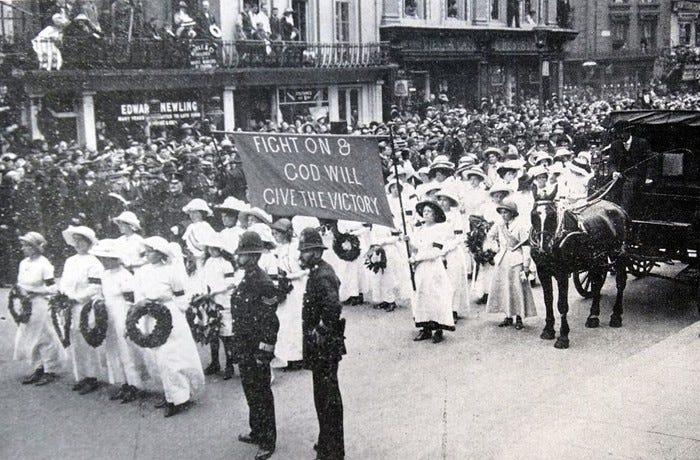
Waithman and Levi, by defending the funeral procession of Richard Honey and George Francis, had furthered the dead men’s proof of the power of a certain kind of nonviolent resistance. They’d helped demonstrate, in particular, what Percy Bysshe Shelley had written after Peterloo. When chaos takes the throne and calls himself order, you can win by throwing yourself in front of his horse. So long as people tell your story, and give you honor. You become proof that the tyrant is not the protector of the people, but a predator on them. You give those who come after the opportunity to prove that you matter, that people like you matter, by calling your death evil. And then, the poem concludes,
As if their own indignant Earth
Which gave the sons of England birth
Had felt their blood upon her brow,
And shuddering with a mother’s throe
Had turnèd every drop of blood
By which her face had been bedewed
To an accent unwithstood, –
As if her heart had cried aloud:
‘Men of England, heirs of Glory,
Heroes of unwritten story,
Nurslings of one mighty Mother,
Hopes of her, and one another;
‘Rise like Lions after slumber
In unvanquishable number,
Shake your chains to earth like dew
Which in sleep had fallen on you –
Ye are many – they are few.’
Postscript
This is a true story. A few minor elements are speculative, but probably true. In the sources I’ve used, the constable who saved Waithman is identified only as “Levi” or “Levy.” Looking at the proceedings of the Old Bailey, the criminal court in London, the only Constable Levi/Levy who appears in that rough time period is Samuel Levi, whose typical beat I’ve inferred from those records. Not all of the Guards who attacked Waithman were in dress uniform, so we don’t know for sure what the man with the possibly-rifled carbine was wearing.
And, as always, there are conflicting accounts of what happened, with government sources claiming that the aggressors were acting in self-defense. Lacking a video, I’m forced to trust the words of the many eyewitnesses who all saw it happen like I’ve said. When evil is done, there will always be people with Honi soit qui mal y pense written on their chests, denying it, excusing it, justifying it. But shame on those who choose to believe them. Shame on all who fail to call it evil.
This was a great read. And very well-written. I really enjoyed it!
Such a great and timely piece! Your research skills are a wonder!