


London businessman, sheriff, and politician Robert Waithman (1764-1833) didn’t write a memoir, but you can paint a pretty flattering portrait using only what his enemies said about him. Waithman had Black friends. He said positive things about Jews and Quakers. He believed in democracy. But some of it is weirder. In conservative publications of the time, such as John Bull, Waithman was attacked over and over for two policies he enacted as Lord Mayor: muzzling dogs during a rabies outbreak, and prohibiting the practice of keeping a live bear in a barbershop.1
As best I can understand it, Waithman’s enemies thought that it was laughably petty to care about protecting human life. It wasn’t about any negative consequences or libertarian objections. It just should’ve been beneath him. John Bull published some satirical “Cockney Sonnets” in ironic praise of Waithman’s actions, where the entire joke was simply that what he did wasn’t actually worthy of a sonnet.
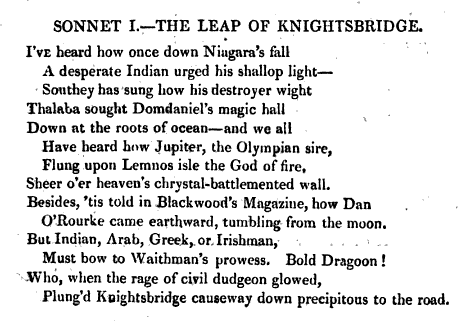
That “plunge” on the causeway is how I opened my first article about Waithman. To me, it’d be an unambiguously heroic moment even if I didn’t like the guy. He put himself in mortal danger to save the lives of strangers, and survived by making a bold and desperate move. But the strangers were cockneys and the people trying to kill them, and him, were war heroes. So John Bull mocks.
When the mayor of Newark ran into a burning building to save his neighbors, his political enemies tried, a bit, to find ways to minimize it. They called it political grandstanding and argued that if he inspired more people to do the same thing, it might cost more lives than it saves. But mostly they just didn’t talk about it and hoped people would forget. It’s hard to imagine an attack ad against Cory Booker that starts with that story. I think we’ve evolved, a bit.
Another example: in Waithman’s London, crimes like shoplifting were harshly punished under the “Bloody Code.” Stealing more than a small threshold amount was an automatic death sentence, usually “respited” to something like 21 years of labor in Australia. Waithman did what he could to fix this in his various government positions—his most significant victory, after many years, was abolishing the death penalty for forgery. He also seems to have done his best to protect people caught shoplifting from him, in his fancy clothes shop on Fleet Street. He’s listed as the victim in only five cases in the Proceedings of the Old Bailey over his thirty year career, and in all of them he declines to testify against the accused, resulting in an acquittal or a downgrading of the offense.
On the other hand, killing someone was often punished quite lightly. In 1794, a young man named John Downes was convicted of stealing six silk handkerchiefs and sentenced to death, respited to conscription into the army. Also in 1794, a man named Robert Andrews was convicted of stabbing someone to death after robbing him, and was sentenced to six months in Newgate Prison and a 1 shilling fine. Because the victim was no longer around to testify about the theft, Andrews’s manslaughter had saved him from a much heftier sentence.
What are you doing, 1794?
Hypothesis: Moral Foundations
The most sympathetic way I know of to talk about this is Jonathan Haidt’s moral foundations theory. Haidt suggests that there are several dimensions of morality, and different people (and cultures) prioritize them differently. Manslaughter, in the sense of attacking someone on impulse and killing them by accident, is worse than shoplifting on the “Care/harm” moral axis, but it’s better on the “Fairness/cheating” axis, because it’s not premeditated.
People often talk about Haidt’s theory in the context of political ideology. In this model, which bears up reasonably well in studies, what makes you a leftist or liberal is that your “Care/harm” moral foundation is much stronger than any other. A libertarian values the “Liberty/oppression” axis, and an authoritarian values the “Authority/subversion” one.
And conservatives? Conservatives care about every axis equally, other than (sometimes) liberty. Care/harm, loyalty/betrayal, authority/subversion, sanctity/degradation, fairness/cheating, plus usually something culture-specific that translates roughly to “honor.” They don’t want people to suffer or be harmed. But sometimes, that value is outweighed by a different moral imperative. Waithman’s arch-nemesis, Sir William Curtis, once described their conflict as “loyalty against democracy.”
An odd consequence of this: talking too much about one particular moral foundation can make you look evil to other people.
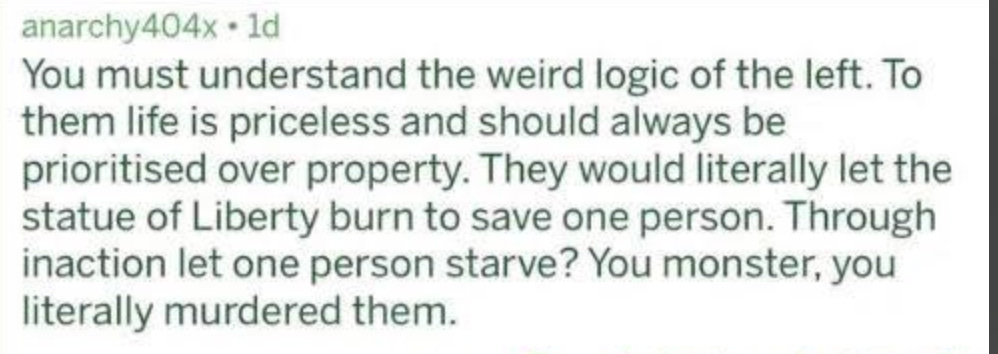
For my part, I tend to stop reading anything as soon as it uses the word “degeneracy” or “degenerate” as a noun. (Using it as verb is okay. Using it as an adjective is dicey and will make me irrationally prejudiced against you even if you’re using it in the mathematical sense.) It’s not that I want our great culture to be polluted by evil ideology and fall into degeneracy and decadence. It’s just that anybody who writes like that is probably willing to sacrifice values that I care about a lot more, to the point where it’s hard to find common ground.
You can probably figure out your own moral foundations by checking how creepy you find the following sentences, out of context:
“If it will save one life, it’s worth it, no matter the cost.”
“We must confront the traitors in our midst.”
“Subversives threaten the fabric of society.”
“These disgusting acts must not be tolerated.”
“Everybody should get exactly what they deserve.”
“I’d throw the world into the fire before dishonoring myself.”
“Nobody ever has the right to tell me what to do.”
This is the best framework, I think, for understanding “vice signaling” in particular. Openly being one kind of evil reassures people that you’re good in the dimensions they care more about. Probably more than it should. Sociopaths can vice-signal too.
Hypothesis: Oh, right, villains exist.
I tend to interpret people’s motivations charitably, maybe to a fault. But every so often, it can be valid, or at least cathartic, to just go “wow, that guy’s a dick.”
If Robert Waithman was consistently on the right side of history, Sir Richard Curtis was even more consistently on the other team. Towards the beginning of their rivalry, Waithman, who was orphaned as a baby, confronted Curtis with evidence that he was embezzling money from a government fund for poor orphans. Curtis responded that he felt it was only his due to give himself the equivalent of $70,000 a year as a bonus for the trouble of managing the fund. (Ignoring, apparently, that he delegated that task to a deputy, who made less than a third that much a year.) Towards the end, Curtis fought to keep the Bloody Code as bloody as possible, supporting the death sentence for white collar crimes (other than his own, of course.)
You can’t totally excuse Curtis by describing him as a product of his time or circumstance. The same culture produced plenty of people who weren’t complete assholes. And while he’s a bit older than Waithman, and came from a bit more privilege, their circumstances weren’t that different. They were businessmen, not nobility, but trying to be politicians anyway. Both were ruthlessly mocked for this. Waithman’s enemies loved referring to him as “Lord Waithman.” They implied that he was illiterate, ignorant, a peasant with delusions of grandeur. They never let anyone forget that he was a linen-draper, a shopkeeper.
William Curtis had inherited his father’s business making ship’s biscuits, and was given a baronetcy (the least posh hereditary title) after giving the Royal Navy a good deal. So his enemies called him Sir Billy Biscuit, and heaped all the same type of class scorn on him. Each has a collection of alleged quotes, all of them stupid or inane, circulated by the other side. “The three Rs: Reading, Writing, and Rithmetic” originated as something Curtis was supposed to have said, not as a joke but because he really didn’t know how to spell arithmetic.
They had the same dress, but they wore it very differently. Waithman embraced the “shopkeeper” label—he was one of the first politicians to treat the common touch as a political asset, not a liability. He was proud and ambitious, but his ambition was all about doing good works. His business did well, but he never allowed his wealth to accumulate—he had very few assets when he died. A former employee of Waithman’s named him, decades after his death, as the person who taught him to be a more ethical salesman. And why would he need to be rich? It didn’t serve any of his goals. His friends and supporters weren’t the sort to be impressed by money, or what it could buy.
Curtis spent his life fruitlessly trying to transcend his humble origins. He wanted the respect of the elite, and tried to buy it with lavish banquets and a swanky estate. To pull that off, he needed to sacrifice any principles he may have had, milking every opportunity. While Waithman was protecting shoplifters in his shop, Curtis was investing in a slave ship that also transported convicted thieves to Australia. When Curtis was chairman of Ramsgate Harbor, he spent the money meant for maintenance on salaries and commissions for him and his friends. Then, when people started dying, he claimed that sailors were crashing their ships in his harbor on purpose.
He may even have persuaded himself that it worked. After all, he was permitted to attend the king’s levees, and even host the king himself from time to time. His family inherited a fortune and his noble title, which remains in the Curtis family to this day. But the whole time, everybody was laughing at him for how he dressed, for his sycophantic version of loyalty, for trying to be a part of an upper class that was deeply uninterested in welcoming new money. Play petty games, win petty prizes.
Waithman was the most important figure in the city of London’s shift to the left, which in turn provided essential support to the national radical movement. He should be more famous than he is. But his name will last longer than Curtis’s. When he died, his friends built him a monument, a two-story obelisk that still stands. When Curtis died, his “friends” sold off his wine collection and spent the money on more parties.

So Curtis is a villain, but, like most, he’s a tragic one. He died rich, fat, and well-connected, his legacy to his family secure. But he sacrificed his dignity, his honor, and (I suspect) his happiness to get there.
Hypothesis: It’s About Power
Whether we call Curtis morally different or morally deficient, we still might not be being cynical enough. Why did Curtis do what he did? Because he could. The corrupt, tyrannical system was never going to correct him, never force him, via consequences, to reexamine his actions.
Curtis brazenly admitted, in public, to pocketing the orphans’ money, because he knew what would happen next: the Tory majority created a subcommittee to investigate the issue, and put Curtis himself in charge of it, where he duly exonerated himself. He and his friends delighted in harassing Waithman with ridiculous criminal charges, knowing that Waithman didn’t have the juice to do much about it.
Why did the state punish shoplifters with indentured servitude, and give people a slap on the wrist for killing a commoner? Because, at the time, it could. Poor people had no power. Only when public opinion became a force in politics did the laws change. Only democracy could bring reform.
For me personally, I don’t have fairness as one of my moral foundations. I want the best for everybody, not just what they deserve. But fairness is a foundation of my political philosophy. We can’t let the assholes get away with it, because a lack of consequences makes a random jerk into a tyrannical villain.
And, conversely, somebody really needs to make a movie about Robert Waithman. They might have to tone down their depiction of Sir Richard Curtis, though. He’s a bit too cartoonishly evil to be believable.
This was a real thing! “Bear’s grease,” made from the fat of a freshly-slaughtered bear, was believed to improve hair growth, since it had certainly worked for the bears. So a few barbers would display live bears in their shops as proof that their baldness cures were made from authentic, locally-harvested ingredients. It was dangerous to humans and torture for the poor bears.
Alternate subtitle? “And the emergence of Western democratic moral foundations in 18th century England”