


But of beauty, I repeat again that we saw her there shining in company with the celestial forms; and coming to earth we find her here too, shining in clearness through the clearest aperture of sense. For sight is the most piercing of our bodily senses; though not by that is wisdom seen…
Plato, Phaedrus, tr. Benjamin Jowett
Previously on Outlandish Claims: The Drumlin Effect, named for the character in Sagan’s Contact, is one of the ways science can, for a time, go stubbornly wrong. Here, I’ll be discussing two examples: black holes and quasi-crystals.
When first we see beauty on Earth, Plato wrote, we shudder in awe, remembering the cosmic truth of which all beauty is a shadow. I am shuddering before the beautiful right now, and this is why:

On the left we have a photo of some of the tilework on the walls of the Al-Attarine Madrasa, a religious school built in Fez in 1325. The colors might not be the originals, but the pattern has (probably) remained unchanged over the past seven centuries. On the far right, we have an electron diffraction pattern of a synthetic alloy, first observed in 1982. In the middle, I’ve superimposed the two images to make it clear: they express the same structure, in slightly different forms.
In medieval Morocco, if you got bored while learning sharia law and started staring at the wall, you’d learn a fragment of a deeper Law. To call it “universal” is to sell it short.
Similar geometric patterns can be found all over the medieval Islamic world. We don’t know for sure why this was their aesthetic, but we can guess. The original artists were working around Sunni teachings that all-but-prohibited representational art—no images of anything, just to make sure nobody started worshipping them as idols. So they invented these techniques, and the results were so cool-looking that even people who were allowed to make pictures of things started choosing to make these instead.
But why this particular kind of abstract art? Why intricate mathematical structures? The artists were downstream of some of the philosophical cultures that historians call “Neoplatonic” or “Neopythagorean”—movements that see mathematics as a way to God. About 400 years earlier, for example, a manifesto from a mysterious group called the Brethren of Ṣafāʾ went viral throughout the Islamic world (and beyond, via Muslim Spain). Ṣafāʾ is usually translated as “purity,” but these writers had an unusual idea of what purity entailed:
...to shun no science, scorn any book, or to cling fanatically to no single creed. For our own creed encompasses all the others and comprehends all the sciences generally. This creed is the consideration of all existing things, both sensible and intelligible, from beginning to end, whether hidden or overt, manifest or obscure in so far as they all derive from a single principle, a single cause, a single world, and a single Soul.
- Epistles of the Brethren of Ṣafāʾ, passage translated by Majid Fakhry.
Their Ṣafāʾ was purity in the sense of “pure mathematics”—don’t shut out the complexities of the material world, but see through them to the simpler world they emanate from. It’s a philosophy that sounds mystical, and indeed it allowed their followers to achieve mystical feats, such as drawing an electron diffraction pattern in 1325.
Like any path that grants mystical power, Ṣafāʾ has its dangers. A corrupted follower of Ṣafāʾ can end up trying to block out the very light they had been seeking. We see this in the tragicomical tales of Arthur Eddington and Linus Pauling.
When a Star Becomes a Black Hole
Sir Arthur Stanley Eddington (1882-1944) used mathematics to reach inside the very stars. He combined Einstein’s theories with the simple approximation of treating a star like a uniform sphere of ideal gas, and wrote, in 1920, a paper titled “The Internal Constitution of the Stars,” the first account of what stars are made of, and why they burn, to be even vaguely accurate.
Having solved one of humanity’s oldest mysteries, Eddington understandably started to overestimate his own abilities. He spent much of his career trying to come up with grand unified theories, based almost entirely on reading deep significance into various experimentally-observed numbers. You could tell he was reaching, because when further experiments changed the numbers, his theories barely changed at all to match.
He also became incredibly stubborn about how stars worked. He’d created a simplified model that made good predictions, but then was hostile towards anyone trying to refine that model, trying to add complexity in order to explain measurements that didn’t quite fit. His war against Subrahmanyan Chandrasekhar was perhaps the harshest example.
Chandrasekhar was born in 1910 in what is now Pakistan, then part of the British Empire. He had a lot of support when he decided to pursue a career in physics. He had distinguished physicists on his father’s side, his mother was a scholar, and he had a prestigious mentor in Arthur Eddington. At first.
According to Eddington’s model, every star will eventually become what he called a “white dwarf,” a star the mass of our sun but packed into a space the size of the Earth, after it runs out of the fusion power preventing its collapse. Chandrasekhar believed there would be some exceptions. An unusually large star, he calculated, would collapse to an even smaller form. If the mass of a star was more than 1.44 times the mass of our sun’s, the gravitational force would overcome the outward pressure of its core.
Eddington hated this theory. A star that collapsed to a tiny point would be so weird that finding one in Chandrasekhar’s model felt like finding a line where he’d divided by zero. Whenever Chandrasekhar presented his papers at the Royal Astronomical Society, Eddington arranged to be scheduled to speak immediately afterwards, so that he could rebut everything. Eddington had enough pull that the organizers refused to give Chandrasekhar the opportunity to defend himself. Even when Eddington pulled the same trick at an international conference in Paris, the American scientist presiding wasn’t willing to go against the great man.
Chandrasekhar didn’t give up. He spoke to the theorists Eddington was citing in his arguments against him: Niels Bohr, Wolfgang Pauli, and eventually Paul Dirac. They tentatively agreed with Chandrasekhar—Eddington’s arguments seemed to be mostly gibberish. But none of them wanted to get involved publicly. Dirac confronted him over dinner at a colloquium in 1939, but Eddington was impervious. The next day, Eddington told Chandrasekhar how disappointed he was that Paul Dirac didn’t seem to understand the implications of his own theory.
There wasn’t much that could be done. Chandrasekhar published one last paper and moved on. Physicists generally felt his math was solid and useful, but also somewhat agreed with Eddington’s intuition: surely in the real world, some natural phenomenon would intervene to prevent a star’s total collapse.
Forbidden Symmetries
Most stars do become white dwarfs. Ours has that destiny. In a few billion years, our sun will expand into a red giant (Earth may or may not survive this phase) and then fitfully shrink, dim, and gradually crystallize. These crystal stars are made of a kind of matter we don’t have on Earth, but structured (we think) in a familiar way: a “body-centered cubic” crystal, the same crystal structure found in common metals on Earth. A crystal consists of a simple form that can bond directly to copies of itself, creating a repeating pattern that can be any size. A body-centered cubic crystal is one where that shape is a cube, with particles at the corners and in the center. There’s a giant model of one in Brussels.

Crystals aren’t all made of cubes, but they’re all made of three-dimensional shapes that can nestle with themselves face-to-face the way cubes can. That rules out, for example, the regular icosahedron, despite its usefulness as a 20-sided die in Dungeons and Dragons.

Regular dodecahedrons, 12-sided dice, can’t form crystals for the same reason. There’s a mathematical proof, the Crystallographic Restriction Theorem, that any shape that can form a crystal must have either 2-fold, 3-fold, 4-fold, or 6-fold symmetry. A dodecahedron has 5-fold symmetry, meaning that if you rotate it on an axis, you’ll display exactly five of its faces on top. For crystals, five is right out.
While Eddington was fathoming stars, American chemist Linus Pauling was fathoming crystals. In 1929, he published a guide to determining the molecular structure of ionic crystals, known as Pauling’s Rules. In the decades following, he continued to study the nature of chemical bonds, earning the Nobel Prize in Chemistry in 1954. Occasionally, someone would claim to have found a crystal that didn’t fit Pauling’s rules. These always turned out to be mistakes—usually multiple different crystals fused together. Pauling was annoyed by these blunders, because the math was clear; the results being claimed weren’t just wrong, but logically impossible.
Or so he thought. The mathematics used to create medieval Islamic patterns had been lost. If he’d happened to have visited the old madrasa in Fez, Pauling might have realized that there were more possibilities.
Instead, the math needed to be rediscovered by physicist Sir Roger Penrose, while he was playing with shapes as a break from his main work: vindicating Subrahmanyan Chandrasekhar.
Penrose’s Impossible Objects
Roger Penrose likes it when orderly things get weird, when every part makes sense but the whole is absurd. As a young man, he loved M.C. Escher’s art, like the famous picture of two hands drawing each other, or his Still Life and Street from 1937.
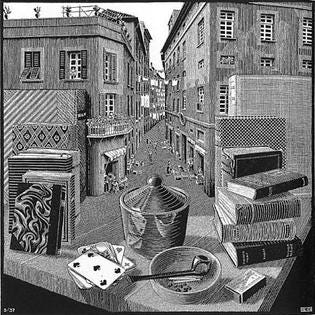
These inspired Penrose to (re-)discover geometric paradoxes that played similar tricks of perspective, starting with the famous Penrose Triangle.

Escher, in turn, used Penrose’s work as inspiration for some of his most famous later work, using his impossible geometries to create waterfalls that feed themselves and staircases you can get lost in.
So naturally, Penrose was intrigued by the “space-time singularity” Chandrasekhar’s theories implied, the warped-space prison created by a collapsing star. It was there in the math, if you assumed the star was a perfect sphere. But unlike his triangle, could it actually exist in reality? Penrose started modeling the collapse of messier stars, stars where some unknown forces might be deforming them during the collapse. In 1965, he published a paper where he demonstrated that even if you took away a lot of the simplifying assumptions astrophysics was using, singularities necessarily developed. The impossible object wasn’t just possible, it was inevitable.
It wasn’t long before astronomers started referring to these singularities as “black holes,” and actively searching for them. They found the first in 1971.
At the same time, Penrose was investigating what we now call “Penrose tilings”: sets of shapes that can be nested together like in a crystal, but without the same kind of repeating pattern. He was particularly interested in sets of shapes that couldn’t form crystal patterns, ones that had to be aperiodic. Here’s the first set he found, full of those forbidden five-fold symmetries:
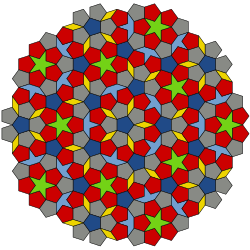
You can form an infinite pattern with these shapes, but it’s the infinity of a spiral, where the repetition only comes from zooming out, not from panning around.
So by 1982, when Israeli chemist Dan Shechtman was assigned to study an alloy of aluminium and manganese, mathematicians were well aware of the possibilities. But the knowledge hadn’t propagated to the rest of science. When Shechtman saw a 10-fold pattern emerge in his scans, he said aloud “Eyn chaya kazo.” There is no such creature.
When Shechtman shared his discovery, his boss gave him an introductory textbook explaining why he was wrong. When that didn’t work, he fired him. His incompetence, he told Shechtman, would bring disgrace on the research group.
It took Shechtman two years to get a journal to publish his paper. At last, he got lucky—one of his reviewers for Physical Review Letters was Paul Steinhardt, who had been following the aperiodic tiling research and looking for applications to crystallography. Steinhardt knew this could be real. Five months later, he and his student Dov Levine published the explanation for Shechtman’s impossible creature, and gave it a name: a quasi-crystal.
Linus Pauling was not happy. “There are no quasi-crystals,” he famously declared, two years into his crusade to debunk Shechtman, “only quasi-scientists!”
Vindication and Post-Mortem
Not all of the stories in this series are going to have happy endings. But Chandrasekhar and Shechtman outlived their Drumlins, and with them the resistance to their ideas. Chandrasekhar was awarded the Nobel Prize in Physics in 1983, and Shechtman the Nobel Prize in Chemistry in 2011. Penrose got his own in 2020.
Though neither Eddington nor Pauling ever backed down, each did their best to stay on good terms with their Arroways, who in turn gave them the professional respect that was legitimately their due. The disagreement would always stand between them. Pauling spent much of his remaining life trying to build models of periodic crystals that would look like quasi-crystals. He had fun with the project, and he and Shechtman tried to co-author a paper about it, but they couldn’t agree on the basic premise and couldn’t find a way around that.
Chandrasekhar gave a visiting lecture at the University of Chicago in 1975 on the typical career trajectories of mathematicians and scientists. Stereotypically, poets and other artists tend to get better with age, but not so in STEM.
In 1817, at the age of forty-seven, when the long period of meditation, during which Beethoven composed very little, was coming to an end, he said to Cipriani Potter with transparent sincerity, "Now, I know how to compose." I do not believe that there has been any scientist, past forty, who could have said, "Now, I know how to do research." And this to my mind is the center and the core of the difference: the apparent inability of a scientist to continually grow and mature.
This is odd, says Chandrasekhar, because surely the essence of creativity is the same for both: the quest for beauty. Chandrasekhar makes a case from personal experience. Not his own discovery, but his reaction to a discovery made in 1963.
In my entire scientific life, extending over forty-five years, the most shattering experience has been the realization that an exact solution of Einstein's equations of general relativity, discovered by the New Zealand mathematician, Roy Kerr, provides the absolutely exact representation of untold numbers of massive black holes that populate the universe. This “shuddering before the beautiful,”1 this incredible fact that a discovery motivated by a search after the beautiful in mathematics should find its exact replica in Nature, persuades me to say that beauty is that to which the human mind responds at its deepest and most profound.
An artist who loses their appreciation of beauty is no longer an artist. Chandrasekhar suggests that perhaps the problem is that scientists can lose their appreciation for beauty, over the course of their work, and still remain scientists2. Aldous Huxley is supposed to have said that “a man of science past sixty does more harm than good.” Chandrasekhar, quoting that line while in his sixties, hopes it isn’t a universal rule. He relates Lord Rayleigh’s reply that older scientists can still do good if they remember to stay in their lanes and not “criticize the work of younger men.”
Postscript: Fatal Beauty in a Glass Bead
Quasi-crystal formation seems to require extraordinary circumstances. As the Brethren of Ṣafāʾ wrote, the simpler the form, the more substances it will appear in. Quasi-crystals are simple, but not as simple as crystals. This makes them quite rare.
Paul Steinhardt, ever since he saw the implications of Dan Shechtman’s discovery, has been on a quest for quasi-crystals. He documents it in his 2019 book The Second Kind of Impossible. Peter Lu, Steinhardt’s advisee, rediscovered the quasi-crystal patterns in Islamic art. Geologist Luca Bindi has found natural quasi-crystals in a meteorite and in fulgurites, rocks created by lightning strikes.3
The quasi-crystal hunters also discovered what is probably the oldest human-made quasi-crystal, created accidentally at the interface between pure mathematics and profane reality. Here’s the story.
As I’ve noted before, there’s a certain irony to Hermann Hesse’s The Glass Bead Game. His game is a stand-in for all purely abstract pursuits. It’s about beauty, perhaps truth, but not utility. Hesse saw a sharp divide between the abstract and the concrete, the beautiful and the mundane.
But while Hesse was writing, scientists and mathematicians were working feverishly on the intensely practical project of defeating Hitler. The Manhattan Project drew on theoretical physics to radically reshape the world…and, as a side effect, create some unique glass beads: the substance called “trinitite” produced by detonating an atomic bomb in a sand desert.
Trinitite has different colors, and different properties, depending on what kind of debris happened to fuse with the sand as it turned to glass. It’s usually green, but some trinitite has a blood-red hue, taken from copper sensor wiring it destroyed. These beads, it turns out, contain quasi-crystals.
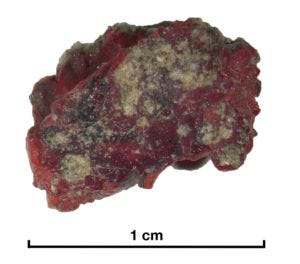
Truth and Beauty don’t care about your intentions, only your intensity. They will manifest in an artist’s quest for the divine, an engineer’s search for a useful alloy, or a nation’s mad scramble to invent weapons of mass destruction. The ideal forms will appear—perhaps as neatly tiled braids, perhaps in drops of blood scattered across the sand.
This lecture, with the quoted paraphrase of Heisenberg who was paraphrasing Plato, would indirectly inspire Nightwish’s Shudder Before the Beautiful, which is my primary association for that phrase. Strongly recommended for fans of heavy metal humanism.
Charles Darwin is one of his examples. Darwin wrote that somewhere in his thirties, he lost the ability to appreciate poetry. He’s perhaps the rare benign example of the Drumlin archetype. He had one big idea, then spent the rest of his life promoting it, defending it, and coming up with models where it explained almost every secret of life. That just happened, in his case, to be exactly the right thing to do.
The oldest scientific analysis of fulgurites comes from the same Islamic Golden Age that produced quasi-crystal tilings. Fulgurites are rare enough, though, that for centuries nobody had any idea where they came from. Charles Darwin was the first to think of lightning as a possible cause. Darwin had one big idea, but he had lots of ideas.