


Emily Wilson wrote a brilliant modern translation of The Odyssey. My credentials as a classicist are that I’ve played both Hades and Hades 2. So I’ve been reluctant to join the discourse around her brutal review of the 2026 film I loved. In order to establish my qualifications to disagree with her, I will first perform a petty little stunt. Here goes: I found a translation error in Wilson’s Odyssey.
The Plot Hole
Homer’s verse is full of exact repetition. This made sense in his oral medium, for similar reasons to why we have repetition in songs. But in a written translation of the epic, it’s super boring, so Wilson tries to translate the same phrases a little differently each time.
To be clear, I think that’s a great choice and well-executed. I particularly enjoyed all the ways she found to translate that notorious “rosy-fingered dawn”. This gambit only goes wrong in one place, as far as I’ve noticed.
When Circe gives Odysseus instructions on how to summon the dead, one of the first steps is to dig a small hole. Here’s how Wilson translates it:
Brave man, go there, and dig a hole a cubit wide and long, and round it pour libations for the dead:
So far so good. “Cubit” is the standard translation for pygōn, the unit Homer uses here. A pygōn is the length from your elbow to your knuckles when you clench your fist, about a foot and a half for the average adult. Circe has instructed Odysseus to dig a 0.15-square-meter hole, presumably a shallow one so that the dead can drink from it.
When Odysseus executes the instructions, the Greek is identical, but Wilson’s English isn’t:
I drew my sword and dug a hole, a fathom widthways and lengthways, and I poured libations for all the dead:
(Emphasis mine). A square fathom is much more than a square cubit! In Homer’s time, a fathom, or orgyiá, was the length from the fingertips on one hand to the fingertips of the other, if you held them out as far apart as possible. In modern times, we call it 6 feet. Odysseus is saying that he dug a hole 3.3 square meters in area. One-handed, since he drew his sword first. That’s pretty impressive. Circe told him to dig a hole the size of a pillow, and instead he’s dug one the size of a mattress.
(Wilson’s translation of other passages confirms that these are different units in her universe. Her giants Otus and Ephialtes are “nine cubits wide, nine fathoms high.” So unless these are idealized perfectly spherical giants…)
This is not a genre where Odysseus should be able to get away with getting his instructions wrong. When a god or a witch (Homer’s Circe is both) tells you to dig a small hole, you have to dig a small hole. Otherwise you end up in a custom-designed corner of the underworld with some ironic punishment like spending all eternity trying to tunnel your way out. And, intuitively, going too far with a ritual for summoning the spirits of the dead seems like the start of a Sam Raimi zombie movie.
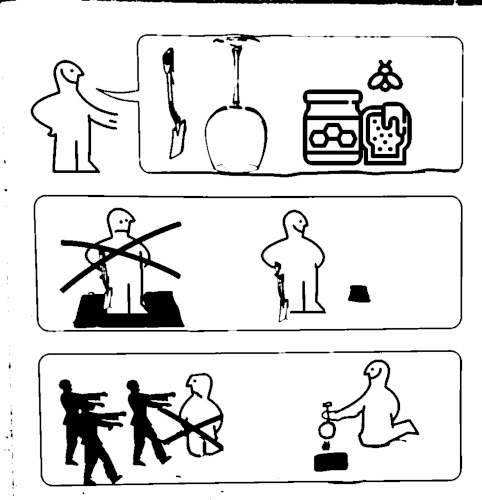
We can try to retroactively justify this. Odysseus could be an unreliable narrator here, boasting about his digging abilities. Or maybe Circe was giving a minimum size and Odysseus was leaving a large error margin to be safe. But I think this is just a mistake.
Now, having established my credentials as a pedantic nerd, let’s get to my actual agenda: demonstrating that Wilson’s review is kind of bullshit or possibly trolling.
Pre-existing Conditions
In her review, Wilson repeatedly represents elements that were present in Homer’s version, or in pre-20th-century adaptations, as though they’re Nolan’s invention. For example, she denies having her heartstrings pulled by
Argos the dog — whose adorableness as a puppy is predictably amped up to suit our animal-loving times. If only the human characters had been treated with such serious attention.
But this is all canon! Odysseus raises him, he’s still a puppy when Odysseus leaves, he’s lying neglected on a dung heap when Odysseus returns, he recognizes him and dies happy. Homer flashes back to Argos-as-a-puppy during that scene. I find it hard to believe that Homer’s audience had a radically different emotional response to ours there, or that that wasn’t what Homer intended. We’re different in many ways from Homeric Greeks, but dogs are dogs.
She derides certain scenes as derivative of Lord of the Rings and Game of Thrones.
At the end of the film, a character sets out to ‘sail beyond the sunset’ and I almost expected everyone to break into Elvish.
That scene, including her quote verbatim and the general vibe, is taken from Alfred Tennyson’s 1842 poem Ulysses.
The long day wanes: the slow moon climbs: the deep
moans round with many voices. Come, my friends,
’tis not too late to seek a newer world.
Push off, and sitting well in order smite
The sounding furrows; for my purpose holds
To sail beyond the sunset, and the baths
Of all the western stars, until I die.
Wilson has written about Tennyson’s poem, of course. On a good day, she would have recognized that line.1 It’s a tidy illustration of one the fallacies at play here. Of course an Odyssey movie would evoke other fantasy epics—those epics were all drawing on the Odyssey. Calling it derivative is a little like the old joke of calling a faithful production of Shakespeare clichéd, because it’s full of phrases you’ve heard a thousand times.
This is the throughline that made me wonder if she was trolling us, with the punchline being her complaint near the end that the “narrative structure is gimmicky.” Direct your complaints to Homer on that one. If anything, Nolan showed surprising restraint. The creator of films like Memento and Inception, adapting an epic as elaborately-structured as this one, could’ve gone much weirder with it.
Contradictions
When Wilson isn’t calling the film an uncomplicated popcorn movie, she’s calling it incoherent in tone and philosophy. She lists “moral contradictions” that include, for example, people alternately extolling sacred hospitality and breaking its rules. I don’t find it incoherent. Just complicated.
Most of her complaints could be directed towards any war movie (or, again, at Homer himself). The story expects us to both admire the soldiers’ valor and deplore the terrible devastation they wreak, to glamorize the fight while condemning the war. Nolan didn’t invent this dynamic any more than he invented feeling sentimental about a cute puppy. It’s only a contradiction if you’ve already decided to hate the movie.
I’m not surprised she hated the dialogue, really. I’m sure hearing someone else adapt the same lines she did, claiming to have been inspired by her work, was always going to be nail-on-a-chalkboard unpleasant. But she rationalizes it:
Attempts at vigorous speech – ‘My dad’s coming home’ or ‘Let’s get off this fucking beach’ – sit uncomfortably next to grandiose meditations: ‘Yes, my queen. The breaking of Zeus’ law, spreading like plague…’
Um. People speak in different registers in different contexts? Odysseus talks like a sailor when he’s talking to his crew, and speaks formally when he’s in character as a beggar given audience by the Queen of Ithaca. What’s wrong with that? The tone shifts both serve the story and make diegetic sense.
Marxist Antinous
Wilson also throws in some standard leftist critiques, painting the movie as sexist, racist, colonialist. I do agree that ethically Nolan and the production company owe the Sahrawi people some money for shooting on their occupied land, but other than that, I think she’s just being willfully blind. She dismisses Nyong’o’s double role as only a “tableaux of female victims” and as a “Black best friend,” a take that is undercut by the fact that one of her roles is Clytemnestra wielding a blade.
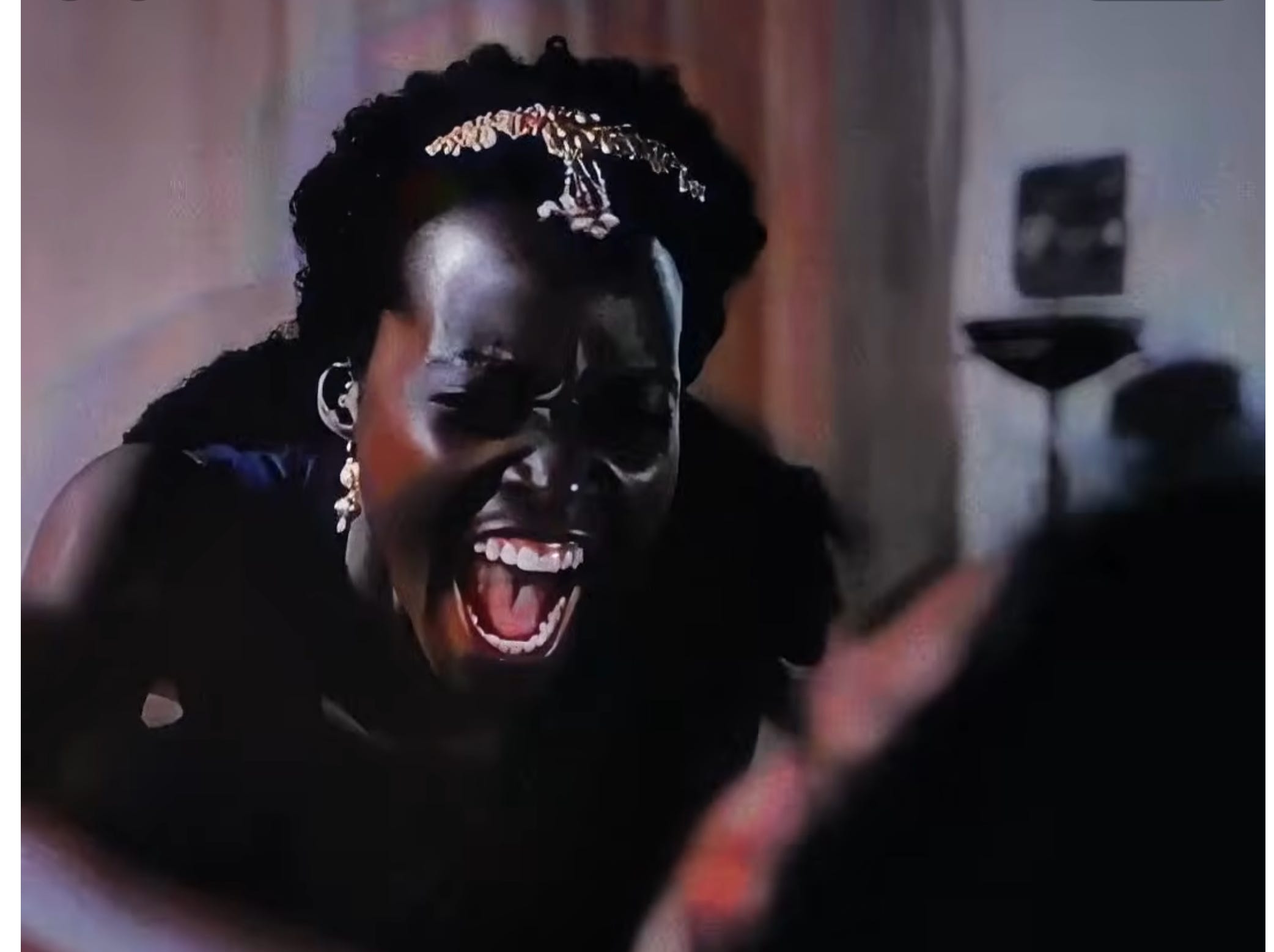
She wanted a scheming, selfish Calypso who wants to keep Odysseus all to himself. I’d argue we get that, in the subtext beneath Calypso’s self-serving narrative.
She complains that she wanted to see a Penelope who had ambivalent feelings about the prospect of Odysseus’s return and the end of her dual role as queen consort and regent. That’s exactly what we get! Not just in subtext, either.
She mourns the loss of Calypso’s bitter speech about male privilege. But that speech is there, given in pieces to Penelope and Circe instead, evoking Madeline Miller’s novel Circe. Wilson is so eager to call the film unfeminist that she erases all of the edge the women in the story have.
Wilson’s critique also invokes one of the more frustrating canards of modern left-wing commentary: that it's morally wrong for philanthropists to directly help people. Here’s Wilson:
Zeus’2 law is…filtered through contemporary American ideas about the importance of philanthropic charity: wealthy people should be gracious towards the poor and hungry in their midst (without necessarily doing anything to mitigate their poverty).
That “grace” in the film consists of giving people stuff, treating them as human, and offering them a little shelter and time to help them get back on their feet. That is poverty mitigation. Then, even more than now, it was often the best even a rich person could do. Did she want Antinous, her favorite character, to kick the beggars out while explaining “Helping you would only serve to paper over structural inequality. True xenia consists of voting for Bernie Sanders!”?
We must’ve taken a wrong turn somewhere
EMILY WILSON is better than this. It must have been really frustrating to see Nolan invoke her, in passing, as an inspiration, and then never actually consult her. I agree that this was a mistake of Nolan’s. She really could’ve helped. But her review, filtered through all that bitterness, is not helpful to the discourse.
Wilson could stand to learn some grace from her protagonist. As Joyce Carol Oates wrote in her own rebuttal of the review, “art is a kind of gift you can spurn, but rage seems just weirdly inappropriate.” When Demodocus the bard unwittingly sings Odysseus’s own Trojan Horse story to him, Odysseus doesn’t interrupt to nitpick the accuracy or the tone. He just sits there, appreciating the performance while grieving the sack of Troy.3 In the words of my favorite translation,
The plate of meat
had plenty left. He told the boy,
Go take
this meat and give it to Demodocus.
Despite my grief, I would be glad to meet him.
Poets are honored by all those who live
on earth. The Muse has taught them how to sing;
she loves the race of poets.
Bonus: The “Sea Peoples” Myth Myth
Okay, one more criticism. It’s tangential, but Wilson’s review is wrong to say that “there was no such thing as ‘the sea peoples’”.
Wilson:
Nolan’s other major addition to Homer’s narrative is the repeated reference to threats to ‘our civilisation’ from ‘the sea peoples’ – a now debunked 19th-century theory about maritime tribes who were thought to have attacked Egypt around 1200 BCE and to have also been responsible for the roughly coeval collapse of Mycenaean Greek culture.
Calling this a “debunked theory” is epistemically confused. Multiple sources, mostly but not all in Egypt, write about “people from the sea” attacking during this time period, and list demonyms for them (some of which sound suspiciously similar to demonyms for Greeks) that appear in other documents. The academic theorizing isn’t about the existence of the Sea Peoples, it’s about who they were, to what extent they were a cohesive body versus a catchall term for any ship-born raiders, and what, if anything, it means that they seem to have grown in prominence at the same time as Greece was collapsing. It probably wasn’t a coincidence; at minimum, the fall of Greek thalassocracy left an empty sea, free to be filled by outlaws.
Tying this historical mystery to the fictional world of the Odyssey is a Nolan original, and I think it’s quite clever. Redditor arandomcouch also finds a kind of support for the conceit in Homer! Odysseus tells many contradictory stories about his travels. If we assume that each of them has a grain of truth, it’s interesting that in one, he sails to Egypt and his crew loots and pillages there.
People really need to get less casual with the word “debunked.” It has a purpose, and that purpose is not served by equivocating among “comprehensively proven false” and “not proven true” and “true in substance but some people embellish the narrative around it.”
This is weirdly not the first time I’ve indignantly accused someone of forgetting about Tennyson on this blog. I think maybe he’s a poet who appeals more to STEM nerds than humanities nerds so he shows up disproportionately in my media diet, giving me an inflated sense of his importance?
At any rate, the original version of her review doesn’t mention Tennyson. It was later edited to almost, but not quite, acknowledge the mistake.
Most style guides, such as Merriam Webster’s, say to spell this phrase “Zeus’s law,” the way it’s pronounced in the film. When I first wrote this line I had a snide “[sic]” here, but that wouldn’t have been at all fair. The AP stylebook requires it be “Zeus’ law,” even though that makes it ambiguous whether we’re writing about a guy named Zeus or lots of people named Zeu. Wilson uses the AP style in her translation, too, though her meter requires it to be read with two syllables. To each their own taste.
Worth quoting to show how well it fits with Nolan’s take. And also how good Wilson is. She’s writing a line-for-line translation of Ancient Greek in iambic pentameter, and somehow it hits as hard as if she’s just talking to you.
Odysseus was melting into tears;
his cheeks were wet with weeping, as a woman
weeps, as she falls to wrap her arms around
her husband, fallen fighting for his home
and children. She is watching as he gasps
and dies. She shrieks, a clear high wail,
collapsing upon his corpse. The men are right behind.
They hit her shoulders with their spears and lead her
to slavery, hard labor, and a life
of pain. Her face is marked with her despair.In that same desperate way, Odysseus
was crying.
Imagine if Emily Wilson had reviewed 2001 a Space Odyssey… The astronauts really didn’t look like they were enjoying their meals at all and we know nothing of their sex life.