


Math fallacies, debunked!
Myth: The PISA test score collapse is not a big deal.
Perpetuated By: Me
Fact: Aaaaaaaaaaaaaah
The Program for International Student Assessment, or PISA, conducts regular standardized tests to measure country- and world-wide trends in student abilities.
The trends are very, very bad.
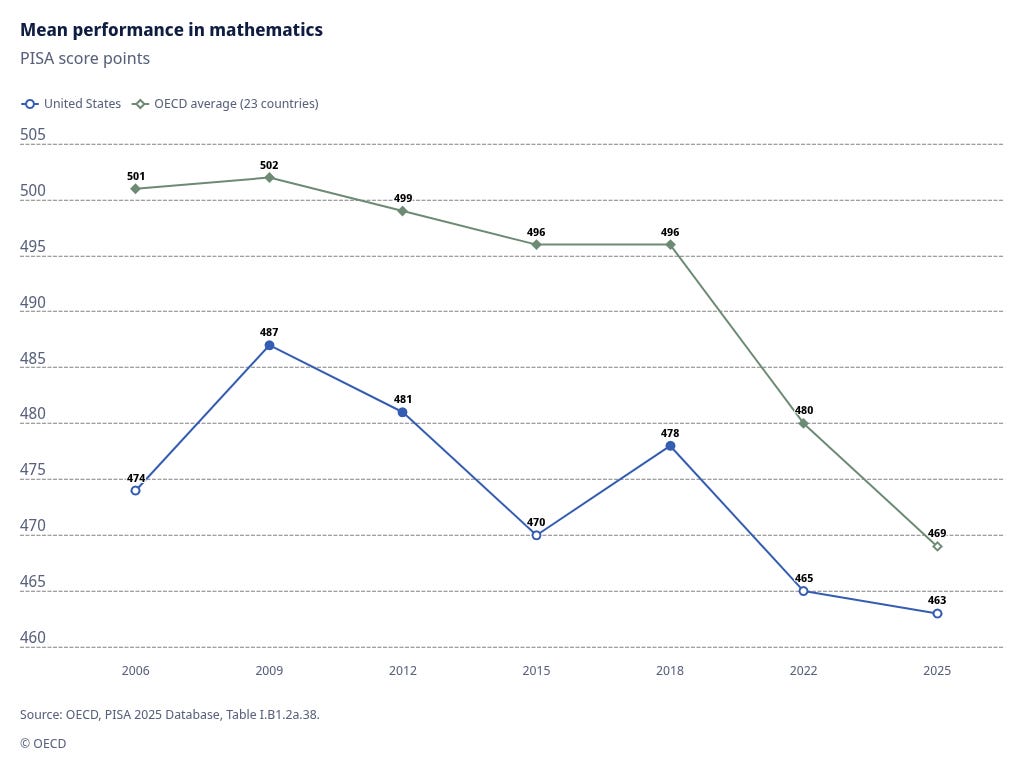
Because of my anti-standards ideology, I spent a while trying to find a way to argue that this was actually fine. I wanted to believe that all it indicated was that the stuff PISA math teaches was getting less and less coupled to reality. I’m sure if we’d had PISA tests on Latin a hundred years ago, we’d have seen a similar crash, and it wouldn’t have been a problem.
But when I looked at sample PISA test questions from different years, they all looked relevant to everyday life and basic skills. I didn’t see any evidence of a decline in PISA test quality. (Except in the Global Competence section, which looks god-awful1). The math questions are stuff like “Here are some figures describing various cars you might buy and how many miles you plan to drive next year. Using a calculator, figure out which one is the best purchase for you.” I want people to be able to do that, and no matter how you slice it, a smaller proportion is able to do it today than twenty years ago.
I may be the only doofus who needed convincing of this point in the first place, but just in case, there you go. Myth debunked.
Myth: Algebra is a Jewish conspiracy.
Perpetuated By: Jess Elofson and Tucker Carlson
Fact: We need more flexible approaches to learning math.
Sculptor Jess Elofson went viral last month after telling Tucker Carlson that algebra was a Jewish hoax. I watched the full context for the clip, or at least everything that looked relevant, so you don’t have to. (The main topic of the interview seems to be the standard “all art I don’t like is a plot to destroy Western culture” thing.) Here’s the algebra story.
Elofson goes to college at the University of South Dakota. He runs into a problem: his degree has a math requirement, but college algebra makes no sense to him. Logically, you can’t mix letters and numbers. Those are two different things. He keeps trying to explain this to his teachers, but they’re too stupid to understand. So he’s in danger of flunking out.
Luckily, Elofson has a friend in the registrar’s office who tells him about this secret math class they don’t want you to know about, Finite Math, which also meets the requirements but doesn’t have all of this algebra nonsense. Elofson finds that class much more accessible, and one of the first things he learns about is compound interest. He vows never to go into debt, and cuts up all of his credit cards.
He concludes that algebra is just there to mess with people trying to learn math, so that they won’t have the math literacy to avoid falling into debt traps (and similar scams such as insurance). If you think you know algebra, he says, it just means you’re in the Matrix (whatever a matrix is). “Good job. You’re good little goy slaves.”
(If I’d had any respect for Tucker, I’d have lost it when he didn’t react to that line.)
So, first of all, fact check: is algebra a Jewish conspiracy?
I’d love to be able to claim this one, but algebra as a concept predates the Jewish diaspora. There’s algebra in ancient Babylonian and Egyptian texts. Furthermore, the word algebra, like most words starting with al, is of Arabic origin. It derives from the title of an introductory math textbook by Al-Khwarizmi, a Muslim in the Abbasid Caliphate.2
Second, I think we can all agree that Elofson’s friend tricked him into taking an easier math class so he wouldn’t fail. According to a review left on ratemyprofessor.com, USD’s Finite Math class was “easy for people who don’t like math.” Their Finite Math course description includes financial math, so the story checks out.
In a sense, Elofson is a math education success story. One could argue that we shouldn’t give jackasses degrees until they learn how not to be jackasses, for the good of society, so in that case we failed here. But in terms of Elofson’s personal success, the system worked. He learned just enough financial math to dodge some of the many ways society exploits the mathematically illiterate. And, as he points out on the show, he uses math in his work. He builds his own kilns using catenary arches. I’m guessing he uses some symbol other than a letter as the placeholder in formulas, so that he doesn’t feel like he’s doing algebra.
Algebra isn’t the real villain in this story—it’s the way we teach math as though it’s a ladder, with each topic a rung you need to climb in order. The strict sequence is convenient for educators, but it means we end up leaving people behind as soon as they hit a topic they can’t understand.
Myth: 2*2+2 = 8
Perpetuated By: Social media threads
Fact: It’s best to use parentheses to disambiguate.
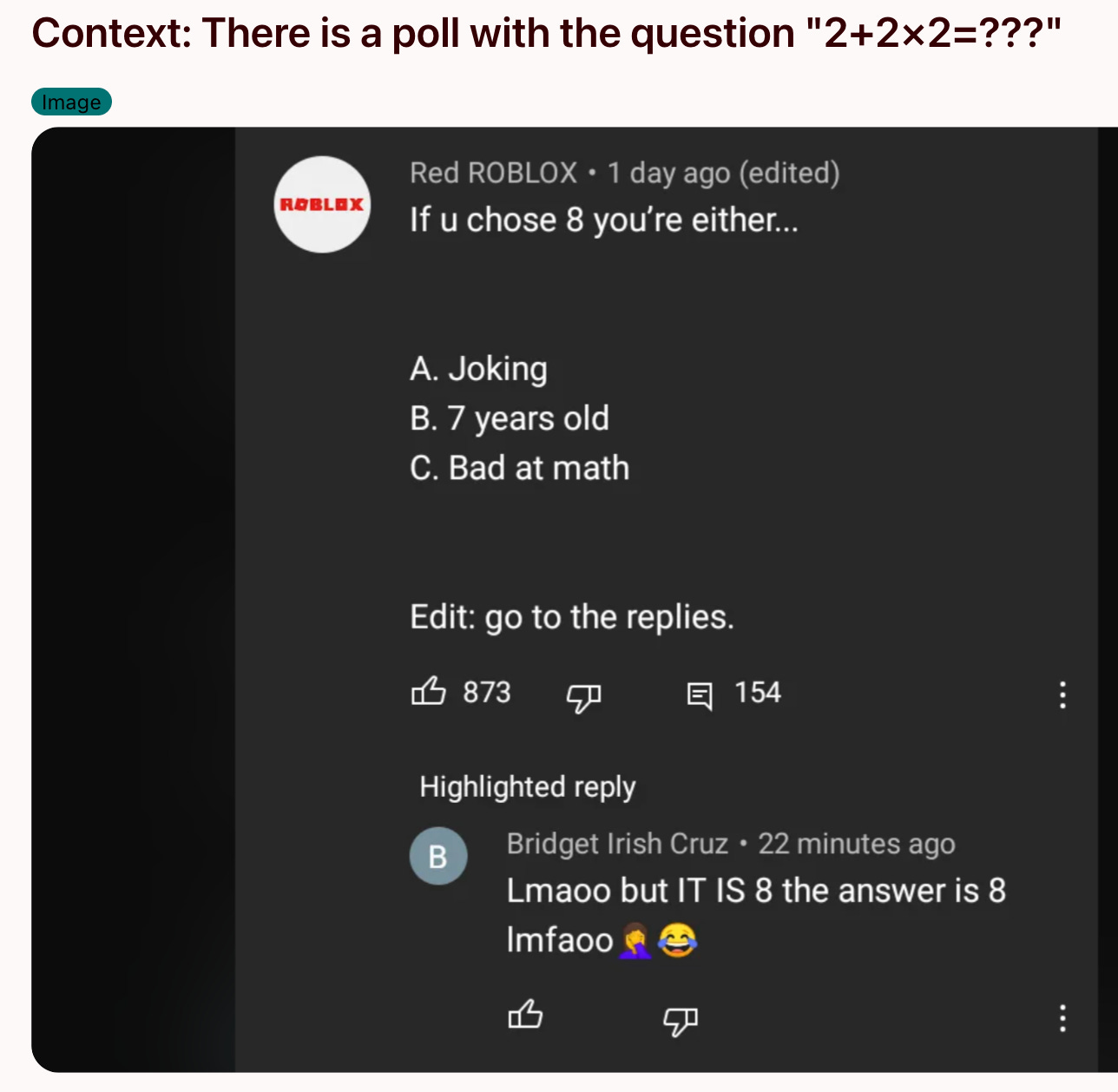
One of the most effective ways to go viral is to manipulate people into confidently disagreeing with each other. This is what’s gone wrong with basically everything in the world, and there is perhaps no purer illustration than a troll asking people what 2+2*2 is.
If you go by the standard convention (PEMDAS or PEDMAS), this parses as 2+(2*2)=6. If you, say, enter it into a calculator, you’ll usually be calculating it as (2+2)*2 = 8. It’s a mistake to say that there’s a right answer to this; it’s just an ambiguously-written question. If you have two children and two pairs of adults in a room, you have six people in the room. If you have two shirts and two hats, and then you buy a duplicate of each, you now have eight articles of clothing.
I’m tempted to blame education here too for not properly distinguishing between fact and convention. Math classes tend to teach “five plus five equals ten” (fact) and “ten is the first two-digit number” (convention) the same way. But I think it’s more that our brains aren’t really wired for this distinction. Decoupling the two is a learned skill in itself.
Myth: 1*1 = 2
Perpetuated By: Terrence Howard
Fact: We don’t usually define multiplication that way.
The actor Terrence Howard is infamous for insisting, among other things, that 1*1=2. All of math education is wrong, he says, because it’s based on the absurdity that 1*1=1.
Howard is making a mistake, but the mistake isn’t really a multiplication error. Rather, he’s missing something fundamental about the nature of mathematical truth. “1*1=1” isn’t the kind of statement that can be true or false in isolation. It requires definitions, axioms, conventions. If you reject the standard definitions, you’re not necessarily doing bad math, just different math3.
If you do multiplication the standard way, multiplication and addition form a ring, which has many useful properties. A big one is that it’s associative: if you have to multiply 3*4*5, you can do it by multiplying the first two numbers to get 12 and then multiply that by 5, or you can multiply 4*5 to get 20 and then multiply 3 by 20.
This is convenient, to put it mildly. If you need to know how much it’ll cost to buy 3 lots of 4 widgets at 5 dollars a widget, you can do the math in any order you want without messing up your answer: $60.
What if, one day, you only need one lot, instead of three? In standard math, you can just replace the three in your equation with a one. In Terry’s math, you can’t; you have to remove the three entirely. Annoying. So I’ll stick with 1*1=1 for this kind of arithmetic.
But sometimes, for example, one needs to do math in a world where all numbers are even, where you’re studying something that always comes in twos, such as nucleotide base pairs. Then there’s no such thing as a 1, but you can still do multiplication and division just fine. If you wanted your numbers to look smaller, you could just divide them all by 2. In that arithmetic system, 1*1 = 2. A ring without the identity element is called a rng, a ring without the i, which I’d find more delightful if RNG weren’t also a common abbreviation for Random Number Generator.
Mathematical truths are always implications. It is fundamentally, universally true that if you define everything a certain way, then 1*1=1. That if-then isn’t a convention or social construct, it’s just a fact. It’s also empirically true that almost everyone uses these terms this way. But if you find 1*1=1 aesthetically displeasing, Terry, you can do good math that fits your aesthetics, with a bit of work. You can’t prove society wrong here, but that doesn’t mean you have to be wrong.
Myth: You should only use numerical probabilities when you’re confident you’re right.
Perpetuated By: Journalists, pundits
Fact: Probabilities are just a language for communicating uncertainty.
As the public becomes aware of the doomsday cult of which I’ve been a long-time member, people seem to be a bit confused to see my folks saying things like “p(doom) = 0.1” or “I think there’s a 10% chance of apocalyptic AI misalignment in the next decade.” I’ve seen complaints that this creates a false sense of rigor when really it’s all subjective and the numbers are mainly sourced to asses.
The reality is that probability is always just quantifying subjective uncertainty. A sufficiently-intelligent god could predict whether a coin is going to land on heads or tails—it’s just a matter of classical physics. When I, a mere mortal, say that the coin has a 50% chance of landing on heads, I’m not wrong. I’m accurately communicating that I know nothing. If someone else tells you “Actually, that’s a biased coin with a 75% chance of landing on heads,” they’re claiming to know something I don’t. They know more than me, but less than the god, so their probability is different.
When you talk about probability in terms of numbers, it creates a bit more accountability than using words. If someone makes 10 unrelated predictions at 80% probability, 8 of them should “come true.” If it’s only 6, or if it’s all 10, that predictor’s model probably has some issues. But if you say “very likely” instead of “80%,” it’s easy to argue, after the fact, that getting 6/10 or 10/10 was exactly what you predicted.
Nate Silver, for example, has quantifiably the best election forecast record in the business. When he says something is 80% likely, historically it’s happened about 87% of the time. I’ve paid less attention to his sports forecasting but it’s apparently been even better. I’ve ranted before about innumerate journalists who think that a probability is like a “regular” forecast, only more confident, to the extent that many of them thought he’d been discredited when he gave Brazil a 45% chance to win a World Cup that they then did not win.
It takes practice to get well-calibrated enough that you can just casually say “80% likely” and have it be more meaningful than saying “very likely.” Fatebook is one tool to help you get started (I spent a fair bit of time using a predecessor, predictionbook). It’s worth it, in my opinion, because it’s a useful skill for forecasting and gambling, and everything in life is a forecast or a gamble.
Myth: Linear extrapolation is always the default assumption.
Perpetuated By: Malthusians, AI skeptics, early covid skeptics
Fact: If the process hasn’t been linear before now, the burden of proof is on you to explain why it’s about to be.
I’ve written a fair bit here about Malthusian predictions for humanity and why they don’t come to pass. What I haven’t done is engaged with the math behind these predictions. I’m…not going to do that in a rigorous way here, but just as I believe that probabilities you make up on the spot are better than nothing, I also believe in the power of crudely-drawn graphs with unlabeled axes.


In a typical Malthusian model, food production grows linearly, if at all, while population grows exponentially, until there’s no longer enough food and it crashes. This is a thing that could in principle happen, but your default guess, when you see two exponential curves, should not be that one stays that way and the other abruptly turns linear.
Julian Simon spent his career defending the “cornucopian” model, where both curves remain exponential, but the burden of proof was really on the two competing models. Malthus needed to explain why we were going to hit an inflection point in the food graph. People who thought we were going to hit a stable state, such as William Godwin, needed to explain why we were about to hit an inflection point in population. Cornucopians would’ve been entitled to just gesture silently at human history and then go about their day.
To be clear, the obvious extrapolation is rarely entirely correct. In terms of what’s actually been going on during my lifetime, food production has continued to be exponential while human population growth has slowed, which doesn’t quite fit any of the three models. Malthusianism, the least accurate one, is partly to blame.
When questioning a naive extrapolation, it’s best to bring in additional data. Humans almost always stop growing after puberty; ergo simply extrapolating someone’s height at age 70 from their growth rate as a child is not going to work. Failing that, you need to make an affirmative case that something is going to bend the curve.
Myth: Math is an assertion of authority.
Perpetuated By: Our status-obsessed monkey brains
Fact: Math is language.
The underlying monomyth here is that someone who uses math, when communicating with you, is doing so to assert or demonstrate that they’re the expert and you should trust them. All math, from this point of view, is either Absolute Truth or Fake: you’re either a real wizard or the Wizard of Oz.
We shouldn’t think of math as lending credibility to an argument, only clarity. Suppose one person says “There’s a wolf attacking the sheep!” and another person says “Wolf-related sheep injuries today are about 2000 times the historical average.” The second one is giving more detail and context to their claim, but they’re not providing any more evidence than the first one is, and the implicit call to action doesn’t have any more moral force.
When someone tells you that 1*1=1, or that 2*2+2=6, they’re not claiming the authority to decree the answers to arithmetic problems. Rather, they’re teaching you the language commonly used to communicate about arithmetic. It’s a good language to know, in large part because it will help you learn mental algorithms for real-world problems. Algebra can help too.
When someone makes a prediction in terms of a mathematical model, the prediction is, at best, only as good as its assumptions. Finding a math error can refute the claim, but finding no errors doesn’t prove it. Rather, it shifts the discussion to the assumptions behind the model, with an added degree of clarity about the implications for the prediction if any of the assumptions are off.
Math is language. It’s a very good language, and more people should learn more of it. If the numbers given by PISA are accurate, and their underlying assumptions are correct, our current strategies aren’t working.
Global Competence was meant to test general skills necessary to interact with foreigners—avoiding bigotry, respecting cultural differences, and so forth. Unfortunately, as one may have noticed, today’s adults are not great at this, and the test quality reflects it. In a test section about stereotypes, “A Single Story,” you lose points, for example, if you say that anti-colonialist websites can sometimes promote overly simplistic stories about a culture. This is impossible, you see, because anti-colonialism is good and racism is bad. The free response question scoring rubric will give you no points for saying “one foreigner being a bad guy doesn’t mean all foreigners are bad guys.” The only acceptable answers are to argue that maybe the foreigner in the story is actually a good guy.
However! Al-Khwarizmi did also write a book explaining the mathematical structure of the Hebrew Calendar. He gave worked examples showing how to figure out when Jewish holidays are going to fall this year. This was a tolerant time, and Al-Khwarizmi had Jewish colleagues, so he had a practical interest in knowing when they’d be unavailable. Ideally, a Jewish scholar would’ve written this, he says in his introduction. But Jews are few in number, and the Jews we have here at the House of Wisdom are, annoyingly, uninterested in calendar conversion math. Looking at Abbasid-era Jewish work it seems like they were more into astrology, which would have involved similar math but in a more complicated and less accessible form.
We don’t know whether this book or his al-Jabr was written first. So for all we know, the scholar who coined the term algebra (and was the namesake of the term “algorithm”) got into the field because he needed a convenient algorithm for knowing which days Mashallah was going to be taking off work.
I read a paper by Howard, and in his case the math is indeed quite bad.
I love the humor in your writing. Also, this article reminded me of Temple Grandin’s objection to forcing people to study Algebra. ( The Atlantic archive, Oct 2022)