


By 1985 enough millions will have died to reduce the earth’s population to some acceptable level, like 1.5 billion people.
- Paul Ehrlich, 1969
The best practical case I can make out is a pretty grim one. Entire nations will disappear. India will break down and become a series of feudal states with only a half or a third of its present population. Bangladesh will disappear. Pakistan will disappear. Egypt will probably go under. So will Indonesia…you can look for severe shortages of food, a nearly complete breakdown of law and order and other chaos right here in the United States and Canada.
- Paul Ehrlich, 1974
I would bet even money that England will not exist in the year 2000.
If the current growth rate should continue, we would double our population in 40 to 45 years. I don’t know of a single ecologist who can think of a way to support 8 billion people successfully on this planet in that time.
-Paul Ehrlich, 46 years ago
A GLUT OF PEOPLE
Prescient Paul Ehrlich and his wife Anne have some answers
-Headline in the Vancouver Sun, 2008
In 1968, married academics Paul R. and Anne H. Ehrlich published The Population Bomb, a pop-science book explaining the dangers of overpopulation. Here’s how it started:
The battle to feed all of humanity is over. In the 1970s hundreds of millions of people will starve to death in spite of any crash programs embarked upon now. At this late date nothing can prevent a substantial increase in the world death rate...
The book went on to call for population control “by compulsion if voluntary efforts fail.”
In 1975, they reprinted The Population Bomb, slightly editing the introduction. The battle to feed all of humanity was still over, but they changed “in the 1970s” to “in the 1970s and 1980s.” The apocalypse had been postponed.
In 1990, they changed the tenses. Their sequel, The Population Explosion, starts by asserting that the prophecy had come true:
In 1968, The Population Bomb warned of impending disaster if the population explosion was not brought under control. Then the fuse was burning; now the population bomb has detonated. Since 1968, at least 200 million people—mostly children—have perished needlessly of hunger and hunger-related diseases, despite “crash programs…
This, as some readers may remember, had not actually happened. 200 million is closer to the total worldwide number of all poverty-related deaths over that time period, most of which were due to plague rather than famine. But anyone who pointed that out sounded like a Reaganite anti-environmentalist. The Ehrlichs retained their platform, and used it to warn America about the dangers of illegal immigration and nuclear power.
Why, exactly, did the Ehrlichs remain influential? It turns out I happen to have a case study conveniently to hand. One of the journalists who continued to respect the Ehrlichs, and promote their ideas, was Jonathan Weiner, the author in 1990 of one of the first pop science books to clearly explain climate change. Paul Ehrlich’s blurb is on the front cover of some editions.
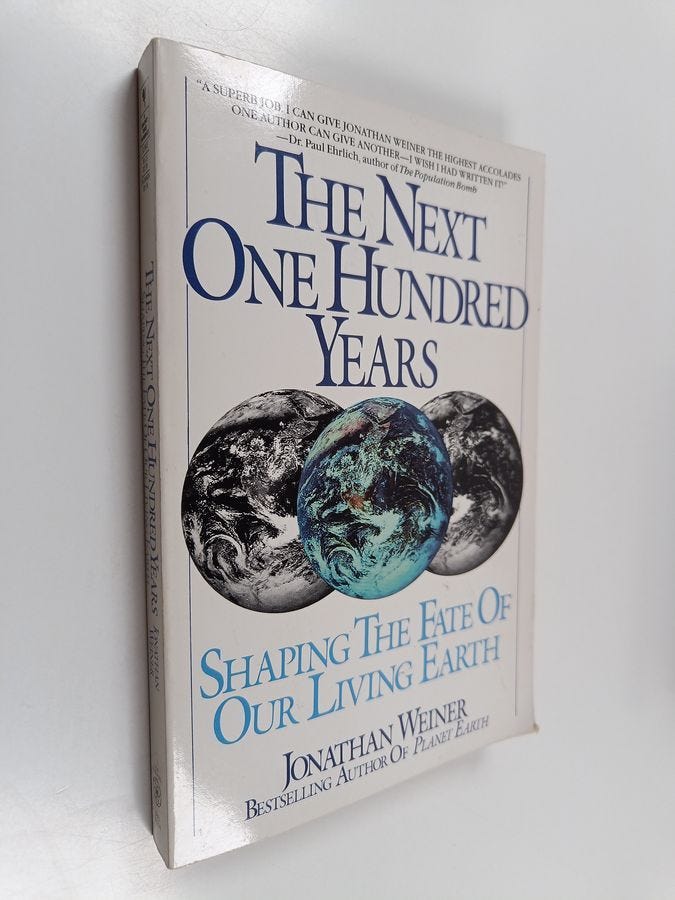
Weiner shared his deep concern over population growth. But if population growth was a bad thing, he was also willing to be part of the problem. As his son1, I’m grateful he made that compromise.
My dad, sheepishly, told me last Monday2 that he can’t remember thinking all that critically about Ehrlich. Paul Ehrlich was famous. His blurb was a big get. If someone is a celebrated ecological theorist known for discussing the near-term future, and you’re writing a book about that topic, obviously you should hear what he has to say.
I have a lot of respect for my dad as a science journalist and critical thinker, but re-reading his book today I have to agree with him: he didn’t think critically enough about what Ehrlich was saying3. Ehrlich only gets three direct quotes, but the book embraces both Ehrlich’s bomb/explosion metaphor and his Malthusian assumptions: when we grow in population, we’ll be punished with a catastrophe that slaps us right back down.
Either we will slow our growth by managing birth rates, or the other spheres of the Earth will control ours by managing our death rates.
When we try to improve the lives of the poor, we’re only accelerating a disaster that will hit them disproportionately anyway.
The heart blanches at the moral, political, and religious dilemmas that face us.
These were false dilemmas. We made terrible sacrifices, mostly at the expense of developing countries, to no benefit, because we listened to someone we had good reason to distrust.
The “The Population Bomb” bomb
Of the disasters the Ehrlichs helped architect, the single worst atrocity had already happened, and been documented, by 1990. From the beginning, they’d been especially eager to reduce the population of India, either by cutting off their food supply or snipping their vas deferens. We should have made them give vasectomies to all “Indian males” with three or more children, they wrote. “Coercion? Perhaps, but coercion in a good cause.”
India, in response to pressure from the U.S., started paying men to accept vasectomies, but it wasn’t enough. The Ehrlichs’ model still predicted disaster. In 1975, India suffered an economic crisis, and the Ehrlichs’ followers finally had the leverage they needed. The World Bank, an international organization set up to help in exactly these situations, told India their support was contingent on them sterilizing at least six million more people a year. The Indian government declared martial law and set vasectomy quotas. Millions of men were arrested, beaten, and forcibly sterilized. India didn’t have the resources to do this many surgeries properly, so thousands of victims got life-threatening infections or other deadly complications. Bigoted police with heavy weaponry seized Muslim towns and sterilized every adult man.
It didn’t work. Not in India, anyway. Their population kept exploding. But state incentives and coercion were successful in curbing population growth in other countries, most notably China. China is now struggling to reverse the effects of their success. They’re offering free IVF and other fertility treatments, and it’s not been nearly enough to undo the damage.
Richer nations like the U.S. were more selective in their forced sterilization programs, seeing the task of curbing population growth as an opportunity for eugenics. If we only sterilized people with disabilities and people on welfare, the theory went, the next generation would be both smaller and higher-quality. The Ehrlichs didn’t start this fire, and the practice had largely died out by their time. They certainly didn’t help stop it, though. It wasn’t formally banned in their home state of California until 1979, and the Oregon Board of Eugenics remained active into the early eighties.
The main effect of The Population Bomb in developed countries was subtler. In the politically left-of-center half of the population, my generation grew up being told that we were destroying the planet just by existing. I probably got a stronger dose of this than most, but we all got the message. About one in three adults my age or younger say they don’t want children, and most of them cite climate change and resource strain in their rationales. Our parents handed out participation trophies with one hand and collective guilt with the other.
This was all wrong.
In 1990, the world had 5.3 billion people, 2.3 billion of whom lived in extreme poverty. Today, we have 8.3 billion people, and only 0.8 billion live in extreme poverty. The precise opposite of a Malthusian catastrophe.4
No part of The Population Bomb was justified by the evidence available in 1990. By 1990, India’s population had boomed, but those new people were enjoying a slightly higher standard of living, not a drastically lower one. The rich got much richer and the poor got a little less poor. The average life expectancy rose by eight years. There were no large famines. This was thanks to agricultural innovations, but also to the stupidly obvious fact that more people also means more farmers, truck drivers, engineers, and inventors. With very few exceptions, it’s been the rule throughout history that the average person creates more resources than she consumes. Otherwise civilization could not exist.
Starting in the 90s, the Ehrlichs and their movement were forced to pivot. They were right about overpopulation, they said, but because it was driving climate change. They might’ve been wrong about our ability to eat, at least in the short term, but they’d been if anything too optimistic about our ability to curb pollution and waste. Humanity was still being punished for our hubris.
But this is just the same fallacy, a degree removed. It’s measuring the evil done by the average person, but not the good.
If we go by estimates from Stanford, home of the Ehrlichs, the total carbon emissions by the United States since 1990 have done about 7 trillion dollars worth of damage to the rest of the world, including projected harm in the future from our actions in the past few decades. At the same time, economists believe the U.S. has been an engine of massive world economic growth. For every dollar richer the U.S. gets, other countries get at least 40 cents richer as an indirect result, including in developing countries. The correlation is higher than that, because trade is mutually beneficial5, but 40% seems like a decent lower bound on the causal relationship. Compounded over the past 36 years, that makes growth in the U.S. responsible for about half of the rest of the world’s wealth, about 46 trillion dollars. On average, each of us was helping more than six times as much as harming.
There are other ways of quantifying help and harm where we might not come out ahead. Other species’ extinction rate and our own’s p(doom) come to mind. And we need to keep looking for ways to get the good without the bad. So these numbers don’t discredit environmentalism as a whole. But the core Ehrlich thesis, that each new human birth harms the whole of humanity, is a toxic pile of bullshit.
Julian Simon as Eleanor Arroway
There’s a good and attractive framing of this sort of debate, “The Wizard and the Prophet,” coined or popularized by the aptly-named C. Mann. The Ehrlichs are prophets of doom, urging people to repent and change our ways, reduce our consumption, before it’s too late. Other people, such as Norman Borlaug, saw the same problem as a challenge to improve our ability to use the resources we have. Put them on the same stage, and the latter starts sounding like they’re promising magic. “I’m going to create more food! I can’t explain how, but…”
Here, I’m going to stick to my Contact framing: if the Ehrlichs are David Drumlin, who is Eleanor Arroway? The opposite of an Ehrlich isn’t a wizard, but someone who believes in magic, who has as much faith in humanity’s ability to thrive as the Ehrlichs have in our ability to die. “Cornucopians,” they’re sometimes called. The most prominent example, during the latter third of the twentieth century, was the economist Julian Simon.
Julian Simon and Paul Ehrlich were both born in 1932, to similar Jewish families, and each grew up mostly in New Jersey. The sixties found them in the same place, ideologically speaking. While the Ehrlichs were writing their book, Simon was in India trying to design an ad campaign to promote birth control.
The point of divergence came in 1967, when economists Simon Kuznets and Richard Easterlin published data showing that population growth, historically, did not have a negative effect on prosperity. The Ehrlichs dismissed this as what they’d eventually call “brownlash,” a pro-pollution backlash that put short-term corporate greed above ecology. Julian Simon took it more seriously, and began examining his assumptions.
So in 1968, while the Ehrlichs were becoming celebrities by sticking to their guns, Julian Simon was quietly worrying that he’d gotten it wrong. A year later, still mulling, he saw a road sign for the Iwo Jima Memorial in Washington, D.C. He remembered reading a eulogy given for the dead at Iwo Jima, where the chaplain had talked about the unknown potential of all those lost. Simon had an epiphany. Here’s how he described it later:
Have I gone crazy? What business do I have trying to help arrange it that fewer human beings will be born, each one of whom might be a Mozart or a Michelangelo or an Einstein—or simply a joy to his or her family and community and a person who will enjoy life?
Simon hadn’t just lost faith in his mission. He’d found a moral imperative in its opposite. In a talk in 1970, he declared himself in favor of the “population explosion,” a position that would define the rest of his career.
It was a position that did not win him many friends. If you cared about the effects of population growth on the developing world, you saw him as a traitor. If you didn’t care, you didn’t see him at all. Polluters had money and societal inertia; they didn’t need an intellectual champion. As Paul Ehrlich’s star rose, Simon could only watch in frustration. (And trade blunt insults with him. These were two Jersey boys.)
Simon didn’t win friends…with one important exception. Ronald Reagan, as President, was super interested in any intellectual justification for the government to do nothing. In 1984, he dubbed Simon’s position “supply-side demographics,” and began advocating amnesty for illegal immigrants, among other pro-growth, anti-regulation stances. Reagan and Simon converted a generation of Republicans. To people like Senator Spencer Abraham, chairman of the Senate Immigration Subcommittee, Simon’s work had helped “keep wide open America’s gates to immigrants.”
But the government didn’t hire Simon, and outside of Washington, Paul Ehrlich won the war of ideas. Simon’s most effective gambit, in 1980, was to offer Ehrlich a long-term bet, as a way of checking whose model was closer to reality. Simon was a long-time gambler, but Ehrlich wasn’t, and it showed. He’d recently said that if he were a betting man, he’d offer even money that England would no longer exist by the year 2000.
Simon told Ehrlich to pick any five raw materials he wanted6, and a date at least a year away. Simon would bet Ehrlich up to $10,000 that the prices of those commodities would decline, adjusting for inflation, over that time period.
Ehrlich picked five metals: copper, chromium, nickel, tin, and tungsten, and an end date in exactly ten years: September 29, 1990. These were five very useful metals and obviously a non-renewable resource, so surely the demand for them would rise with population while the supply dwindled. “The lure of easy money can be irresistible,” Ehrlich wrote in his public announcement of the bet.
Simon won the bet handily. All five of the commodities Ehrlich picked declined in real price over the period Ehrlich chose. For three of the five, you didn’t even need to adjust for inflation. Ehrlich complained that he’d been conned, somehow, but he did pay up. He could afford to. Two months before the bet was formally over, he was awarded a MacArthur “Genius” grant for $345,000. “I can’t even get a McDonalds,” grumbled Simon. The $576.07 from Ehrlich could buy him as many as several burgers, but it’s clear who the real winner was.
The Ehrlichs never recanted. They eventually admitted that the “battle to feed all of humanity” was not, in fact, over. The famines they had called inevitable had not happened. But, they said, that failed prediction was just meant as an example. Their real thesis had been that something catastrophic was bound to happen as population grew. They hadn’t predicted global warming specifically, but they still felt vindicated by it.
It took far too long for them to fall from grace. Over the next decade they did some incredible damage. To the Clinton administration, the Ehrlichs and their allies and disciples were environmentalism. They decided to take drastic action to reduce immigration from poorer countries, since as Americans they would do more damage to the environment7. By the time environmentalists started to question the Ehrlich position, during Clinton’s second term, harsh laws were already on the books, and the snowball was rolling that would become MAGA.
Just Look (People) Up
In hindsight, 1990 was a missed opportunity. This was the year the Ehrlichs’ prophecies of famine definitively failed, plus the year Paul lost his bet, and it fell right when environmentalism had good reason to start to shift focus towards carbon emissions. The Ehrlichs could have repented, quietly or loudly. Or people could have simply stop listening to them. None of that happened, and so we squandered eight crucial years. What went wrong?
It seems to come down to willful blindness. The Ehrlichs were simply not interested in personal accountability. They were warriors, and they’d committed to their side. Here’s how their 1990 book describes the atrocities in India they’d helped cause:
India’s family-planning efforts suffered a major setback in 1976 when Indira Gandhi’s government, recognizing that the population-control effort was floundering, stepped up pressure on government employees (who comprise a large fraction of the work force) to be sterilized after having a third child.8 The move was so unpopular that it was a major cause of Gandhi’s being voted out of office in 1977.
They took themselves and the U.S. out of the story, and they erased six million victims. It’s hard to change your mind about anything when you don’t remember ever doing anything wrong.
And journalists didn’t hold them to account. The only people attacking the Ehrlichs were climate change deniers, happy to use their poor record to discredit all environmental alarmism of any kind. Nobody else was interested in embarrassing them. Even people like my dad, who had come into this project with an open mind, didn’t think to check whether the people predicting the next one hundred years had gotten anything right about the previous twenty. He didn’t interview, or read, Julian Simon.
Those of us who grew up marinated in collective guilt can find it hard to understand those who didn’t. Many of our elders seem to have a hard time imagining their own actions having any kind of negative consequence. Ideology can create an even stronger form of cognitive dissonance, where people end up explicitly believing that their ideas can’t possibly do any damage. Quoth The Population Bomb:
If I’m right, we will save the world. If I’m wrong, people will still be better fed, better housed, and happier, thanks to our efforts.
Will anything be lost if it turns out we can support a much larger population than seems possible today? Suppose…in 2151 mankind decides Earth is underpopulated with just 2 billion people. Men decide that they want more company. Fortunately, people can be produced in vast quantities by unskilled labor who enjoy their work.
Set aside that the harmless efforts they’ve just proposed include the United States taking “unilateral action” in the developing world, on the grounds that forcible sterilization is “coercion in a good cause.” Imagine instead that population control was achieved perfectly ethically. In this imaginary scenario, tens of billions of people have been prevented from existing for no reason. Even if your sense of population ethics doesn’t see that as an inherent harm, the sliver of humanity we did allow to exist would have been horrifically wronged. When the bell tolls for the never born, it tolls for thee.
Just Look
If one missing ingredient is accountability, there’s still the question of how the Ehrlichs managed to get everything they were studying wrong. For example, why exactly did Paul Ehrlich lose his bet with Julian Simon, when Ehrlich himself had set the terms? We can tell a simple story about each of the five metals Ehrlich had bet would become more expensive.
Engineers in the U.S. and Germany figured out an efficient way to extract copper from copper-oxide deposits, making copper much cheaper. The first plant opened in 1982.
The price of tin had been artificially inflated by a cartel, the International Tin Council. They went bust in 1985.
Chromium was expensive because it was used to make stainless steel. Engineers in South Africa had already found a better way to make it, and in the eighties their technique was adopted worldwide.
There actually was a nickel shortage in the eighties, driving the price up! But then manufacturers responded by finding ways of using less nickel, and at the same time more people started mining nickel because it was now more lucrative. By 1990, the price was slightly lower than in 1980.
Turned out there was a lot of tungsten in China, so when they decided to globalize their economy, they glutted the market. That had actually started earlier, but then an earthquake damaged some of their mining operations, and it took them until the mid-eighties to get back on track.
Naturally there’s more to all those stories than can ever be told, but let’s run with these reductive explanations.
In three of the five cases, the key facts were already known in 1980, knowable in principle to Ehrlich via research. The inventions that would make copper and chromium cheaper had already been invented. China had already started mining tungsten for export.
The other two were predictable given some basic economic literacy. When something is expensive, people are incentivized to make more of it, even if they can’t personally use it. The tin cartel didn’t control all of the tin on the planet, so the more they drove prices up, the more competitors they created for themselves. Nickel was scarce because it wasn’t profitable enough to mine it, so it got more expensive until it was profitable. The system was not in equilibrium. It could’ve taken more than ten years, but it was always going to fix itself eventually.
The Ehrlichs thought of humanity in terms of ecology, not economics. In an ecosystem, if a species runs out of a necessary resource, it dies. When the reindeer population on St. Matthew Island outgrew the island’s carrying capacity, birds didn’t see their desperation and start airlifting in plants to sell them. Cross-species trade isn’t completely unknown in nature, but it’s not the norm. The laws of supply and demand aren’t laws, there, just suggestions. An ecosystem normally deals with starving reindeer by letting them starve, then devouring their corpses. An economy normally deals with starving people by helping and exploiting them.
They also underestimated human potential. Ecosystems innovate and adapt, but rarely fast enough to avert catastrophic loss. Civilization often does better. By the time the World Bank was pressuring India to sterilize its men, India was already becoming self-sufficient in its food production. The Ehrlichs waved that aside, writing that the Green Revolution in agriculture was a one-time, unsustainable fluke. But by 1990, India had become a consistent net exporter of food. The people we’d tried to prevent from existing, so that we wouldn’t have to feed them, were now feeding us.
The Ehrlichs and Simon saw the world through different lenses. The Ehrlichs thought it was realism versus optimism. Simon thought it came down to a respect for personal and economic liberty. I’ve just framed it as two competing world models. But there’s another factor at play, too, and this one may have secretly been decisive.
After Paul Ehrlich visited India, he described an undifferentiated mass of “people, people, people, people.” Flesh piled up unsustainably high, a terrifying mess. After Julian Simon visited, he described individuals. One was a fourteen-year-old girl in extreme poverty, working on a construction site while her baby lay nearby on a burlap sack, covered in flies.9 The difference wasn’t his optimism, it was his empathy.
When Simon saw an Indian man driving a goat harnessed to a hand mower to cut a lawn, he connected it to his own experiences mowing lawns as a child and young adult. He’d been able to mow as much in an hour as this man could in a week, he reckoned, because he had better tools and better infrastructure. Get those same tools into the hands of India’s multitudes, and you unlock incredible potential.10
If you see people for who we are, you’ll never bet against humanity. To be a true prophet, you need to have a little faith.
Dun dun DUUUN!
Appropriately, we spoke during Yom Kippur, the Jewish Day of Sheepishness.
Or, as he pointed out to me, about the media’s tendency to erase Anne Ehrlich, who seems to have been an equal partner in their work. Incidentally, Julian Simon occasionally collaborated with his wife, sociologist Rita J. Simon.
Some more stats for skeptical readers: While the world was adding three billion to our population, the child mortality rate in developing countries fell by two thirds. Our definition of extreme poverty shifted upward—people living right on the poverty line are twice as rich as they were in 1990. Life expectancy rose in all income brackets. Sure, the rich got richer, but the poor got richer too.
Insert pointed cough here.
The flexible terms here reflect either desperation or a deranged level of optimism from Simon. People ran simulations later and decided that if you picked a random span in the 20th century and random commodities, Simon would have lost two thirds of the time.
This was quite possibly the only time they were persuaded by Simon about anything. They spent the eighties saying that too much immigration would make the U.S. poorer by straining our resources. Then, they acknowledged in The Population Explosion that all immigration, including from Mexico, makes America richer on net. Their actual policy views were unchanged.
This was indeed part of Gandhi’s mandate, just not the most impactful part. Government officials were also told they would not get paid unless they turned over their quota of citizens for vasectomies. Teachers turned in their students’ parents. Police arrested random men on imaginary charges. If they claimed to be childless, or to have already had a vasectomy, they’d beat them until they changed their minds.
I have this from a circuitous route—Simon’s transcript in his autobiography of a talk given by Paul Silverman, in which Silverman paraphrases some of Simon’s descriptions in the course of condemning him. Two weeks after that talk, Simon dumped a drink on his head at a party. Did I mention he was from New Jersey?
Paraphrased from Simon’s autobiography A Life Against the Grain.
Great post, Aaron, one of your best. I have to read it over again and think very hard about what you say. There's a lot here for me to take in, a lot, speaking as an old environmentalist (and a Jersey Boy). Yes, how fitting that you and I talked about this on Yom Kippur.