


“Telescopic philanthropy” I have no faith in. We must do good to those who are about us, and most dependent on us, until the little circles of love and kindness, widening as they move outward, at last meet, and the whole world is an abode of peace and happiness.
- Pro-slavery opinion piece in the Charleston Daily Courier, 1853.
Across six large-scale and cross-societal datasets spanning 743,402 individuals in 121 societies, we find a robust positive relationship between ingroup and outgroup prosociality…When people are not made to choose between the ingroup and outgroup, they are generally prosocial toward both.
- Study by Kasper Otten, 2026. Via Astral Codex Ten.
(content warning: racist text, racist images, consequentialist ethics, more racism)
1. Honest Love
Don’t you just hate those sanctimonious, self-styled “altruists” who care more for the people they think they see in their telescopes than for the wretches lying at their own feet?
The sentiment is ancient. Confucius and Aristotle had similar complaints, they just didn’t have telescopes. The telescope metaphor is usually attributed to Charles Dickens, but the earliest example I’ve found is from the political cartoonist George Cruikshank in 1826:
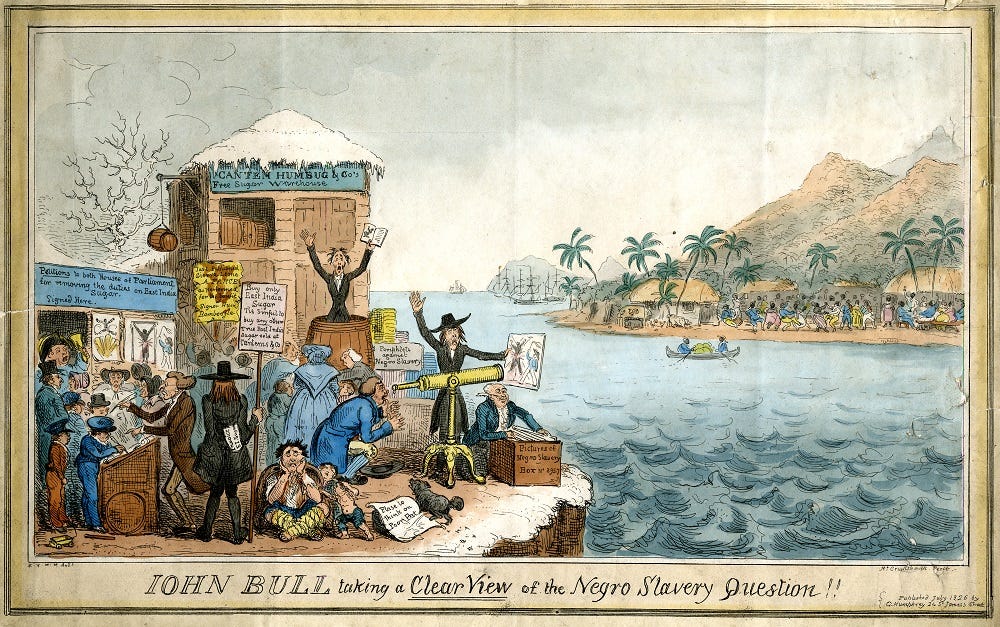
John Bull, the symbol of English public opinion, is being hoodwinked into caring about overseas slavery (which, we can see in the distance, is actually totally chill and fun). It’s all a scam to get support for removing the tariffs on ethically-sourced, slavery-free sugar. Meanwhile, poor White locals are sad and neglected.
This was a standard line of attack from progressives and conservatives alike. William Cobbett was willing to admit in passing that he hated slavery—but he hated abolitionists much more, as his 1823 open letter to William Wilberforce makes clear:
Away with your cant about the happiness and the morality of the Blacks. You will take us next to the baboons and the monkies; and indeed, anywhere to make us lose sight of those who are suffering under our eyes, and screaming aloud to us for help.
Unsurprisingly, the telescope metaphor stays overtly racist for a long time. Dickens’s chapter in Bleak House titled “Telescopic Philanthropy” introduces Mrs. Jellyby, who cares more about organizing humanitarian work in the made-up land of “Borrioboola-Gha, on the left bank of the Niger” than tending to their own households. At the time he was writing, these missions were still mostly motivated by fighting slavery (they’d morph into colonialism soon). His satire doesn’t mention slavery, but English people on both sides of the debate immediately made the connection.
In the American South, writers immediately decided that “telescopic philanthropy” was when you cared about Black lives, no matter how near or far. When I search for the phrase in newspaper archives, basically all of the hits for the next 20 years are from opinion pieces in Southern newspapers condemning abolitionism, and then (after they lose the war) civil rights and miscegenation. Some of them go through contortions to justify using the phrase to describe Americans, who hardly needed a telescope to see chattel slavery up close. Harriet Beecher Stowe harbored fugitive slaves and wrote fiction based on their accounts. Doesn’t sound very telescopic to me, but Stowe, says a letter published in the Charleston Daily Courier on October 29th, 1853, is gaining “heartless foreign praise” by sacrificing “the honest love of a plantation of slaves.”
Most, though, didn’t bother trying to square that circle. British colonists in New Zealand referred to caring about Maori as “telescopic philanthropy,” even though in New Zealand you’d need a telescope to see anyone who wasn’t Maori. A New York Herald editorial used it to describe aid to the “emigrants in our midst.”
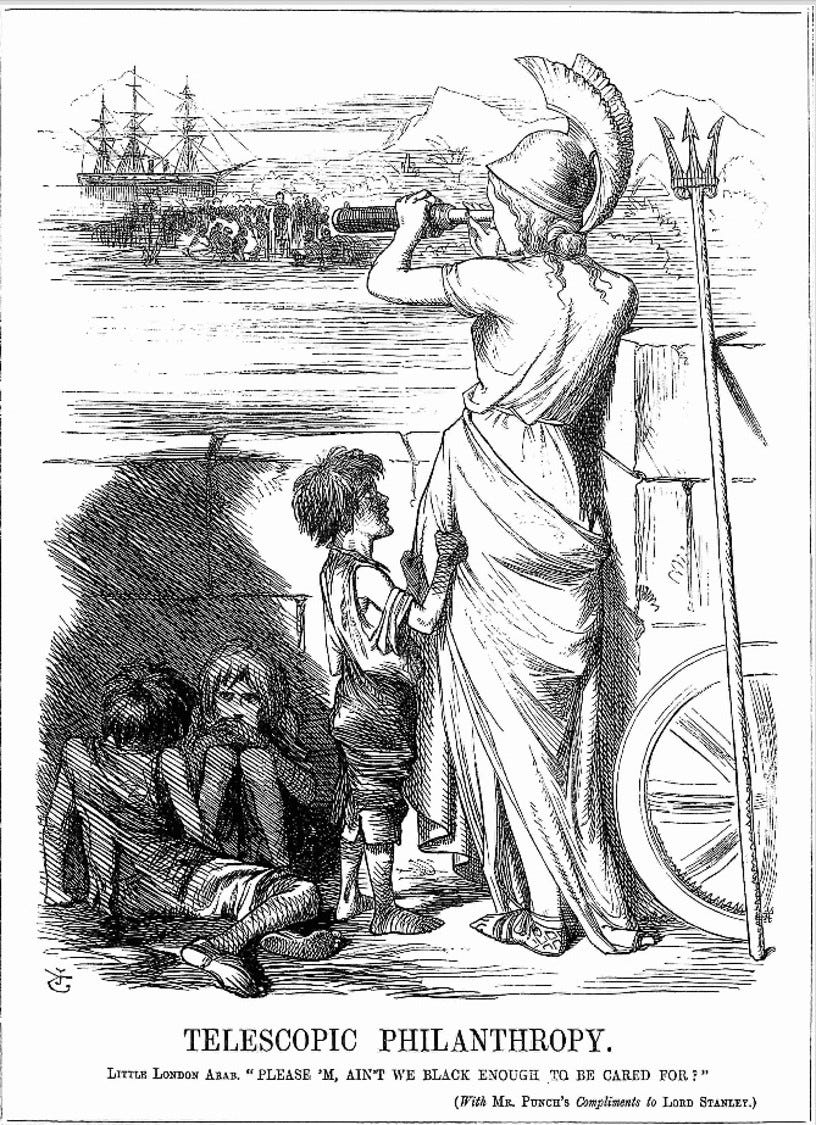
2. Robber Barons
“Philanthropy,” in the nineteenth century, typically meant something closer to what “altruism” means today. The word was coined to mean “love of people,” and hadn’t yet narrowed to only mean a rich person demonstrating that love via money. When Robert Treat Paine attacked the “absurd philanthropy” of the Marquis de Condorcet, he wasn’t complaining that Condorcet was donating too much money, but that Condorcet was writing about universal love, animal rights, and so forth.
When the word shifted meaning, it took all that animosity right along with it. Philanthropists are taking the money they got by exploiting people at home, and giving it to…well…it’s still usually generic Africans, as we see in this 1905 caricature of John D. Rockefeller.
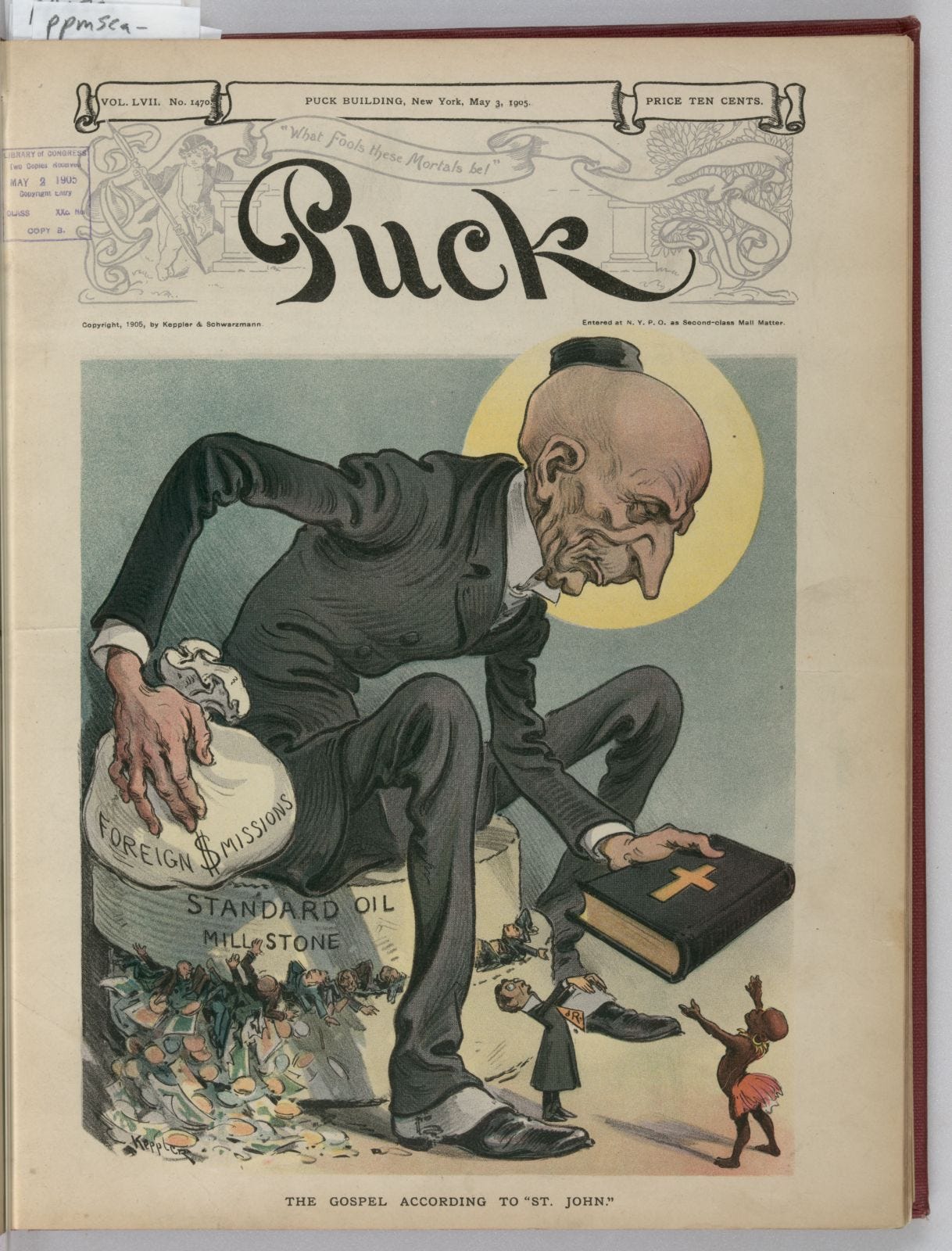
In our enlightened, post-racist modern day, the cartoon usually leaves the African out entirely.

Per the accompanying article,
For effective altruists, a good cause is not good enough; only the very best should get funding in the areas most in need. Those areas are usually, by EA calculations, developing nations. Personal connections that might encourage someone to give to a local food bank or donate to the hospital that treated a parent are a distraction—or worse, a waste of money.
The classic example of an EA-approved effort is the Against Malaria Foundation, which purchases and distributes mosquito nets in sub-Saharan Africa and other areas heavily affected by the disease. The price of a net is very small compared with the scale of its life-saving potential; this ratio of “value” to cost is what EA aims for. Other popular early EA causes include providing vitamin A supplements and malaria medication in African countries, and promoting animal welfare in Asia.
…
GiveWell calculates that in 2021 alone, it directed over $187 million to malaria nets and medication; by the organization’s math, that’s over 36,000 lives saved.
Those 36,000 lives don’t make it into the cartoon, because the typical reader is no longer expected to sneer at their skin colors. Although I can’t help but notice that the people being squished by the billionaires all appear to be just as light-skinned as the people being squished by Rockefeller.
3. Revisiting Mrs. Jellyby
It’s not always all about race. The first usage I’ve found of the phrase “telescopic philanthropy” is more about class. In an 1838 tract, Reverend William Fletcher warns of “the wild and unsettling vagaries of a species of telescopic philanthropy…sacrificing our interests as a great commercial nation to…speculative doctrines…”
This is just one example, says Fletcher, of the pernicious effects of partisanship, now spread throughout the land by the recent expansion of the right to vote. Allowing middle-class men to vote had corrupted and distracted them.
“Our’s was a happy home,” said a poor woman to me one day with tears in her eyes, and the marks of wretchedness in her appearance, “before my husband had a vote…
I certainly would never accuse a man of God of telling a falsehood. But despite his very real and not fake story, the term didn’t catch on until 1852. That’s when Charles Dickens realized that it’s easier to blame a woman for the state of her home, rather than a man. Mrs. Jellyby has a supportive husband and a full-time maid, but we’re still meant to understand implicitly that the wretched state of her household is her fault. The problem isn’t that her husband is depressed and her maid is bad at her job—those are just symptoms. The root cause is that Mrs. Jellyby’s eyes “could see nothing nearer than Africa!”
Dickens is hostile and mocking throughout, but to a modern eye, Mrs. Jellyby’s sins in this chapter don’t carry quite as much weight. In order, we learn that:
She had free-range young kids who dressed in rags and ran around getting into scrapes (with adults ready to rescue them if needed), and weren’t allowed to bother her during work hours.
She “had very good hair, but was too much occupied with her African duties to brush it.”
Her clothing was similarly untidy.
Her desk was simply covered with papers.
Her teenage daughter resented being drafted into helping with all the paperwork.
The house was functional, but very messy.
The claim that she “could see nothing nearer than Africa” is undermined by her very first line, where she greets her guests warmly and speaks highly of their mutual acquaintance. She’s driven, and distracted, by the seemingly-random cause she’s obsessed with, but she’s still human, still connected to the people around her. Today, the cause could be climate change, or world peace, or malaria. You’ve met this person. You might be this person. Modern TV shows introduce protagonists with scenes like this.
If Dickens were trying to make her ridiculous today, he’d have to try a little harder.
4. Zooming Out
Charles Dickens only grew more racist with time, but he did stop hating Jews. This was because he eventually made a Jewish friend, the woman who’d bought his old house from him, who argued him into making Oliver Twist less anti-Semitic. His later writing shows that he understood, somewhat, the folly of bigotry against Jews. He just failed to generalize.
It’s not that there weren’t any ex-slaves in London. Legally, a slave who set foot on British soil was automatically free, so it was a popular endpoint for fugitives. But nobody who’d escaped from British chattel slavery made any real estate deals with Dickens, so they never became real to him. Even after he toured the U.S. and witnessed, with horror, the reality of American chattel slavery.
In private letters, Dickens went so far as to call for the total extermination of everyone in India, as a response to a rebellion in 1857. It was impossible for British people to empathize with Indians, he wrote to a friend. He kept trying to explain this to women he knew, but they just didn’t understand. They thought they were empathizing, but they were deluding themselves.
You know faces, when they are not brown; you know common expressions when they are not under turbans;
I’d like to stipulate here that Dickens was making a mistake, not expressing a fundamental moral principle. If he’d gotten to know more brown people, he’d have had the same realization about them that he’d had about Jews. But he never did.
Given that assumption, if we wanted to help Dickens evolve, we could take him to a British slave plantation (while they still existed) and show him that it was even more brutal then the American ones. We could introduce him to brown people, with and without turbans. There’s no reason to think this wouldn’t work…but it would be a bit inefficient and scattershot. He’d repent of his bigotry against Indians, but as soon as he heard about violence in New Zealand, he’d be calling for genocide there, because he’d never met a Maori.
A telescope might help, but it would still be too slow for one lifetime. Although maybe, from the right vantage point…

4. Mathematical Ideology
Not everyone needs a telescope. You can also just do the math.
As the engineer and philosopher Mozi, born in China circa 470 BCE, wrote:
Suppose everyone in the world loved everyone else, universally, as they loved themselves. Then, by assumption, they would love their families and neighbors.
Mozi also wrote that objects in motion tend to remain in motion unless acted upon by an outside force, and wrote extensively about optics.
Two thousand years later and five thousand miles away, Isaac Newton ended his own book about optics with a meditation on how scientific and moral progress require both experiment and inference.
And if natural Philosophy in all its Parts, by pursuing this Method, shall at length be perfected, the Bounds of Moral Philosophy will be also enlarged.
His co-inventor of calculus, Gottfried Leibniz, put it more plainly and liberally:
But the principle of justice is the good of society, or more precisely, the general good, for we are all part of the universal republic of which God is the monarch, and the great law established in this republic is to procure as much good as we can for the world.
…
Faith is not needed to know this great maxim; it is enough to have common sense…
Indeed, the mathematician Condorcet was a devout atheist when he arrived at his own “absurd philanthropy” that advocated for everyone’s rights and welfare equally, regardless of class, race, or gender. You don’t really need any particular belief system to notice the simple generalization from experiment: if you can love the random sampling of humanity you personally know, it’s probable that everyone is worthy of the same love. It’s the appropriate default hypothesis, in advance of further investigation.
5. Confessions of a Telescopic Philanthropist
In writing in defense of telescopic philanthropy, it occurs to me that the people I need to persuade might be more moved by a personal account. I think, in some respects, I’m a typical convert to the modern-day iteration of the movement. Mozi called it jian xiang ai, jiao xiang li, universal love turned to universal benefit. Leibniz called it caritas sapientis, charity done wisely. Will MacAskill and Toby Ord called it effective altruism.
For my first few years working in tech, I didn’t donate much to charity. I thought of myself as an altruistic person, but I was skeptical of any organization’s claim to effectiveness, and thought maybe, one day, I could do better. I told myself I was putting off donating until I knew more.
I also very rarely did volunteer work for charity (it always involves talking to people, you see). I lived and worked in New York City, so ignoring beggars was part of my daily routine. I worried that all of this not-helping meant I was secretly a bad person, or that it was slowly making me into one. But I had plenty of things to feel guilty and anxious about, and this one barely cracked the top five.
Then, probably from LessWrong or something in that sphere, I learned about GiveWell, a charity evaluator that actually tries to evaluate impacts! It doesn’t just measure how much stuff a charity does, or credit it with everything good that happens in the area it touches, or uncritically accept an organization’s description of its own impact. It runs randomized controlled trials measuring overall impact, so any indirect harm of an intervention has that debited against the direct good.
GiveWell predates the term “effective altruism” by a few years, but EA’s embrace of GiveWell helped bring it to my attention and lend it more credibility. It all still could’ve been a scam, or misguided, but it was the least scammy-looking, most promising “give me your money” pitch I had ever seen. Their top recommended charity was the Against Malaria Foundation, which had a reassuringly bare-bones-looking website and very little publicity. It sure looked like the kind of organization that might spend my donations on the actual thing, not “raising awareness” of the thing.
Ever since, I’ve been sending 10% of my paycheck, each month, to AMF. When I don’t have a regular income, but get bursts of cash from stocks vesting or whatever, I donate 10% of the bursts to whichever short-term aid group GiveWell is currently recommending. I’ll never know for certain that I’m not being scammed. Until last year, I had only second-hand evidence that the continent of Africa existed. If I were doing all of that giving in my own neighborhood, I’d have a bit more confidence that I was actually doing good. But I’ll take (to make up numbers arbitrarily) a 90% chance of a large impact over a 99% chance of a smaller one.
Occasionally, people would share concerns about AMF or GiveWell’s methodology, such as the worry that the insecticide-treated nets might be used for fishing, contaminating the water. I’d look into them, check them against the math, and satisfy myself that they were being taken into account in the calculations. It was not a lot of work—other people had done the heavy lifting.
On average, I think each of those monthly donations has saved approximately half a life from malaria. In total, AMF estimates that 66,496 people have slept under nets those donations paid for. Looking at those numbers has usually been enough for me to feel better about my life, on days where the other 90% of it has felt misspent. Sometimes, AMF will share photos or videos, and I’m guessing that’s emotionally load-bearing for some donors. But I think the numbers tend to make me happier than the videos.
I also occasionally read or participate in the Effective Altruist forum, where people argue about and analyze the various threads of EA: aid to the developing world, animal welfare, preventing human extinction, and long-term projects. Something that I think gets missed about EA is that it’s a big tent, with wildly different definitions of altruism coupled to broadly similar ideas about effectiveness. Here’s what the forum looked like in 2018, for example:
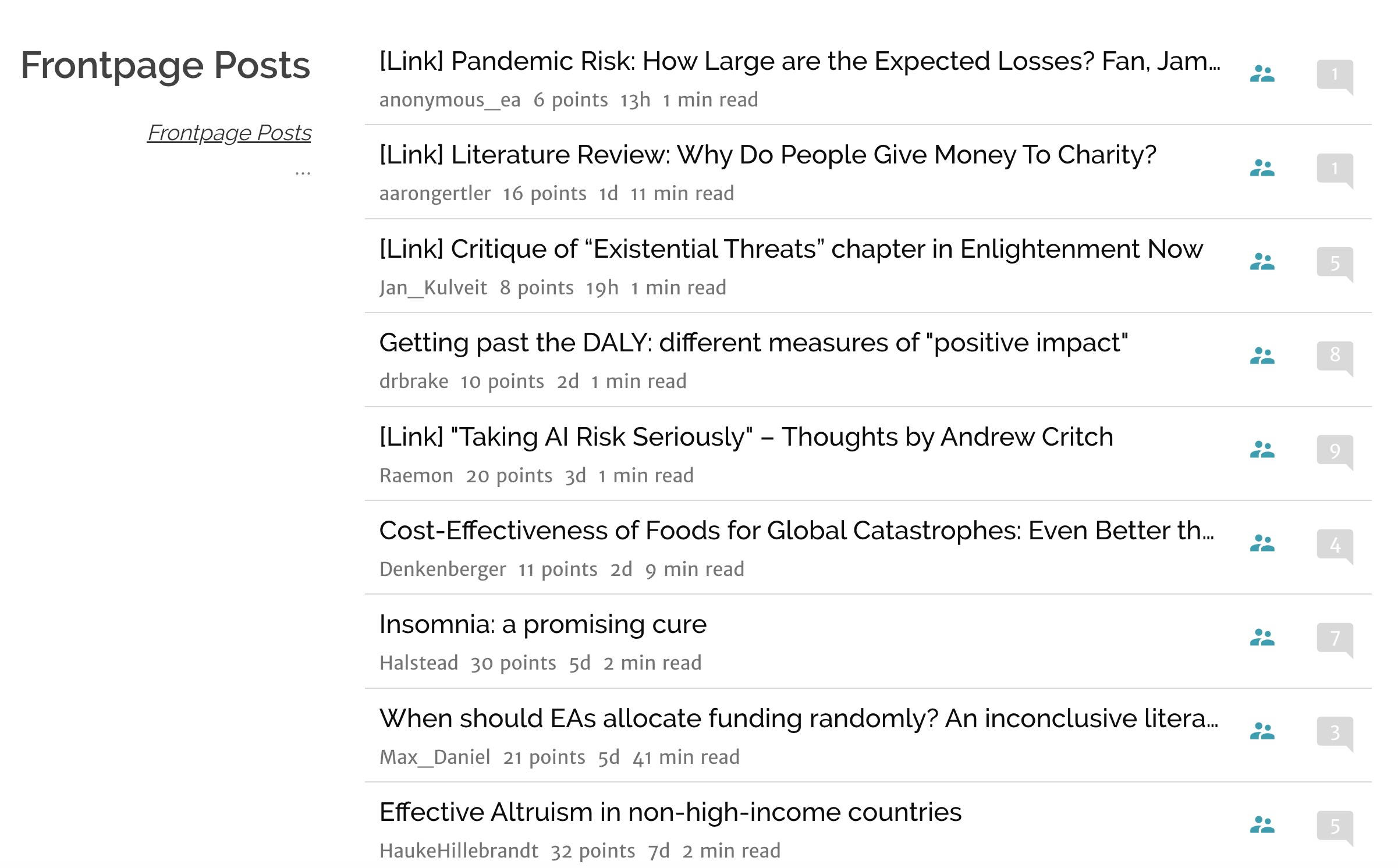
This is what I think about when I see people writing “I hate effective altruism because it promotes the wrong charities, as I will now argue in detail!” Anyone who writes that is of our party without knowing it. Take it to the forum, friend.
(Also, yes, EA was worried about pandemic risk in 2018. As a rank-and-file EA, what this meant for me personally is that in February of 2020, when I caught a respiratory disease with flu-like symptoms and had to fly home anyway, I wore a goddamn mask.)
6. This is why everyone hates the Journal of Moral Philosophy
Linking opposing views to historical racism is not exactly my go-to rhetorical move. It’s pretty cheap, and it won’t win me many points with the EA crowd. I’m doing it here because of this:
The Sanders cited here is Brenda Sanders, whose essay “How Effective Altruism Fails Community-Based Activism” explains that she was once told that a prominent animal rights donor would never fund her work (vegan film festivals) because “there’s no way to prove how effective it is.” Sanders is Black, the donor isn’t, so…q.e.d. really. She concludes that refusing to “support work being done by a Black activist in Black communities is upholding white supremacist ideas about which communities are worthy of support and which ones aren’t. In other words, it’s racist, plain and simple.”
I’d like to suggest an alternative framing. Throughout the history of moral philosophy, there have been two competing schools of thought. One says that you should try to help as much as possible, without worrying about who you’re helping. The other says that you should only try to help your own kind. One says that you should check, afterwards, whether your help actually helped. The other says that’s unnecessary; you can tell you did good if the process was wholesome.
People of both schools have done great good and great evil. It’s a hard task. There’s no easy road. But, as a “plain and simple” rule of thumb, we should err on the side of universal love.