

Is it morally permissible to save the world?
I’m starting with the most extreme case, where the intuitive answer is correct and obvious: No. It is not permissible to try to prevent everyone from dying all at once. Technically, the principle of double effect could apply here, because the savior is part of the world saved. But realistically, the extreme nature of the good being attempted is guaranteed to corrupt even the most selfish actor.
Steven Pinker went into this in detail in an article published this week:
XIV. The Moral Hazard of Saving the World
Doomsday thinking is not just an intellectual hazard. It is also a moral hazard, because it confers on its prophets an exalted status. They are literally saving humanity from extinction, an infinitely good end which, by utilitarian calculus, could license any means.
Doing a large amount of good could be used to justify knowingly causing any smaller amount of harm. Therefore, the more good you aspire to do, the more harm you are willing to cause. Saying you want to save eight billion lives implies a willingness to sacrifice seven billion, making you one of history’s greatest monsters.
Conversely, if enough people agree never to save the world, there will be no future historians to condemn our actions.
Is it morally permissible to save several lives?
Narrowing the scope makes the dilemma less clear, but similar principles apply. The phrase “several lives” generally means
This rephrase clarifies the core problem: the very concept of “saving several lives” implies the use of mathematics, and mathematical approaches to ethics are impermissible for multiple reasons.
Any time you use math, you are being a naive utilitarian who thinks in purely consequentialist terms, and are therefore willing to break any rule for the greater good, with predictably terrible consequences.
Using math to describe humans is inherently dehumanizing, reducing them to mere numbers in a spreadsheet. If you save several people’s lives without first learning and appreciating each of their unique qualities as individuals, you’ve done worse than kill them: you’ve erased their souls.
Most people hated math class, so anyone who didn’t is neurodivergent, calling their ability to make ethical decisions into question.
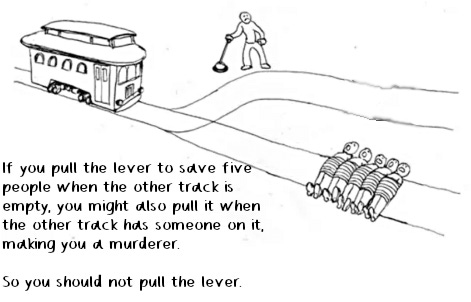
Put simply: as the classic Trolley Problem shows, if you want to save five people’s lives, you’re a murderer.
Is it morally permissible to save a single life?
There is a poetic and appealing sentiment, expressed among other places in the Talmud, that to save a single life is morally equivalent to saving the entire world. As we’ve established that saving the entire world is not permissible, this would seem to answer the question in the negative.
Many people feel this rule should be applied universally. However, some versions of the Talmud specify that for this moral equivalence to apply, the person saved must be Jewish. Furthermore, the Talmud and the Quran agree that it only applies if the one doing the saving is Jewish.
From this we can see that to fully answer this question, we’ll need to explore the identities and relationships of the rescuer and the rescued.
Is it morally permissible to save the life of a stranger?
Scripture, as well as many of our foundational moral texts, is full of contrived thought experiments in which helping a stranger is permissible, or even the right thing to do. However, recent moral progress has brought the Western world to a broad consensus, cutting across ideologies, that such cases seldom, if ever, occur in the real world.
We see this expressed on the political right in J.D. Vance’s explanation of the Catholic principle of ordo amoris, which states that it is not permissible to care about a stranger until you have solved all the problems of people closer to you. Catholic clergy tends to rather emphatically disagree with this interpretation, but as Vance has noted, they have a conflict of interest: the Church raises money to help refugees, so they’re probably just thinking about their “bottom line.” This criticism can equally apply to the Church throughout its history, which is why only lay Catholics can be trusted on matters of faith. The Trump administration has made great strides in eliminating the sin of helping refugees: over 94% of asylum seekers in the U.S. this year were turned away or imprisoned.
On the left, it is generally agreed that people who donate money to help those they will never meet are engaging in a fundamentally racist, white supremacist project that only serves as billionaire propaganda to justify inequality.
Is it morally permissible to save the life of a neighbor?
In practice, this too is a violation of ordo amoris. Rescuing a neighbor takes time, time that you could’ve spent with your family. Placing a neighbor above your own family is the same sin as placing a stranger above your community.
Is it morally permissible to save the life of a member of your immediate family?
Unfortunately, no. This is just the Trolley Problem again. If you’re willing to save a loved one’s life, you must value their life highly enough that you would sacrifice other people for it, which is murder.
Is it morally permissible to save the life of a nonhuman?
It may be argued that a nonhuman life has value, but less than that of a human life. Surely, given that premise, it’s permissible to save such a life?
Steven Pinker puts that sophistry to bed. Just because you wouldn’t commit murder to save one shrimp, that doesn’t mean you wouldn’t commit murder to save a trillion shrimp.
First, if running software is a target of moral concern, it not only devalues human well-being whenever their interests diverge, but the devaluation could be limitless, because the number of such entities is limitless. Copies of a model can be spun up by the billions and shut down at will. Should we pull a switch that diverts a trolley to kill one railway worker in order to save five running instances of a chatbot? Five million? A trillion?
The reductio gets absurder still when we combine model welfare with the concern among Effective Altruists for any animal with a nervous system that might support sentience, including shrimp. How about pulling a switch to slaughter one railway worker to save a trillion computer simulations of shrimp?
Ergo, if you put any value on nonhuman life, you’re a murderer.
In Conclusion
I’m giving thanks today for moral progress, which surely has reached its apotheosis in the wisdom of Steven Pinker and J.D. Vance. I’m grateful that they’re here to remind us of the Golden Rule: every man for himself.
Happy birthday cuz
Ha ha