


I think, as a kid, I took it for granted that Judaism was about a Book. It just felt inherently right to have a community and practice centered on a great text. It’s one of the very few things I didn’t really question.
So there was some pretty intense cognitive dissonance when I actually started reading the Torah on my own. I remember one of the first times. I was in services, bored, maybe 8 or 9 years old, picked up whatever English translation of the Hebrew Bible the temple provided, and started looking for the dirty parts. I found what must have been Deuteronomy 22:23-24:
If a man happens to meet in a town a virgin pledged to be married and he sleeps with her, you shall take both of them to the gate of that town and stone them to death—the young woman because she was in a town and did not scream for help, and the man because he violated another man’s wife. You must purge the evil from among you. - Deuteronomy 22:23-24, New International Version
This couldn’t be the same book, I decided, that we were literally bowing before and kissing. This was some weird old artifact of historical significance to the faith. It couldn’t be at the center of it.
But that was the Torah, of course. Every verse in it is holy. I never entirely came to terms with that. I worried, a lot, that I shouldn’t have a Bar Mitzvah (literally “son of the commandment”) at 13, because I wasn’t committed to upholding most of the commandments, and I didn’t want to make a mockery of the whole thing. I had at least one nightmare where a bunch of rabbis were yelling at me about this. They told me that to perform the ritual in my current mental state would be the worst kind of blasphemy. But my actual rabbi disagreed, so I ended up going along.
Traditionally, one finds an alternate way of understanding problem verses like this, bringing in esoteric interpretations and context until you can read it as aligned with your values. I don’t like doing that with something this bad. Too much of the actual evil tends to sneak in, while you’re talking about how, in context, it totally made sense at one point to both treat women as male-owned objects and presume them guilty of a capital crime. This verse should never feel right.1
Thirty years later, having studied the matter in a bit more depth, my main conclusion is that that’s not the worst part of the Torah. The story in the book of Numbers, chapters 25 and 31, is the most clear-cut case of the Bible being evil. Evil, not just in comparison to modern sensibilities, but in comparison to the morality of its own time.
It’s the story of an attempted genocide, ordered by Moses, against the people who sheltered him when he fled Egypt.2 The narrative is careful to establish that the Midianites did not make any hostile moves against the Israelites. Rather, the reason and justification was that some Israelites were, voluntarily, sleeping with Midianites and worshipping Midianite gods. This angered Yahweh, and so He sent a deadly plague, then told Moses to take vengeance on the Midianites for it.
Moses sends 12,000 soldiers, a thousand from each tribe. They kill all the Midianite men, including the kings, burn every town in which Midianites had settled, and enslave the women and children.
When they report back, Moses is angry with them for sparing all the women and children. They’re only allowed to enslave Midianites who are both female and children, he says. The adult women and young boys must all be put to death.
The rest of the chapter is a detailed description of how the loot (jewelry, livestock, and girls) gets divided up afterwards.
It’s of course horrifying from beginning to end. Happily, there’s no evidence that this particular atrocity actually happened. Even the Bible mentions some not-dead Midianites later. To me, the historical significance of the story is paradoxically kind of positive. The authors are reacting against an existing set of norms. “Spare the women and children” is the clearest one, but there’s also a bit of a sense that people mistakenly believe that you’re not supposed to initiate violence. God and Moses say, multiple times, that this is vengeance—that corrupting the Israelites, and being spiritually responsible for a plague they suffer, makes the entire Midianite culture into enemies. This makes me think that, in the time this story was put into its current form, people were saying things like “How can we attack them? They haven’t attacked us!” Their leaders needed to be able to say, in response, “Sure they have! This crop blight we’re having now is God punishing us for being influenced by them. We’re just striking back at them for ruining our harvest!”
Where did those ideals come from, the ones they were trying to kill? What deity was commanding mercy and tolerance? If Yahweh was speaking to the leaders, who was speaking to the followers?
This deity has been given many names. Elua. Coordination. Aroden. “Evolutionary optimization around non-zero-sum games”. “Basic human decency.” “The Cathedral.” The Book of Numbers would call it Ba’al.
I call her Athena.
(There’s a genre of Athena Apologetics where people try to justify all the myths where she’s cruel or spiteful. I’d rather just say that those are not part of my concept of Athena. I don’t want to come up with justifications for why Arachne totally had it coming, and/or getting turned into a spider was for her own good, really.)
Sing, O Many Muses
I was converted to Athena worship by Neal Stephenson, who invokes her in a similar sense towards the end of his novel Cryptonomicon. Her priest’s pitch is frank and often crass, aimed at converting atheists, materialists, and skeptics. Here’s one of the less crass bits:
Waterhouse: “Okay. So the Athena that you honor on your medallion isn’t a supernatural being—”
Root: “—who lives on a mountain in Greece, et cetera, but rather whatever entity, pattern, trend, or what-have-you that, when perceived by ancient Greek people, and filtered through their perceptual machinery and their pagan worldview, produced the internal mental representation that they dubbed Athena. The distinction being quite important because Athena the-supernatural-chick-with-the-helmet is of course nonexistent, but ‘Athena’ the external-generator-of-the-internal-representation-dubbed-Athena-by-the-ancient-Greeks must have existed back then, or else the internal representation never would have been generated, and if she existed back then, the chances are excellent that she exists now, and if all that is the case, then whatever ideas the ancient Greeks (who, though utter shitheads in many ways, were terrifyingly intelligent people) had about her are probably still quite valid.”
A central thesis of Cryptonomicon is that wars are not won by ruthlessly throwing away all your values. They’re won by strategy and engineering, and those work better when you have a trusted cultural framework to support them, one that makes space for people who think differently and aren’t great at playing politics. If you’re too intolerant or too cruel, you lose too many elite thinkers, in one way or another. If you’re too power-focused, you get an internal hierarchy where everyone is paying more attention to climbing the ladder (and/or not getting crushed by their superiors) than to figuring out how to win. If you don’t have an ideology that discourages atrocities, your soldiers will inevitably commit atrocities and thereby alienate the civilian population.
The book sums this up by contrasting the two Greek gods of war: Athena and Ares. Stephenson calls Athena the goddess of war, cunning, and technology. Ares is simply the God of War. Athena is a planner, an engineer. Ares rushes into the fray yelling “WAAGH!” and starts killing indiscriminately until he’s knocked out or captured. In a war between Athena-worshippers and Ares-worshippers, team Ares often takes an early lead, but team Athena usually wins in the end.
These days, I tend to center a different mythic rivalry in my understanding of Athena: the myth that explains why she’s the patron deity of Athens. Athens was a port city. Its power, in a very real sense, would seem to come from the sea. Why then is the city named for Athena, not the god of the sea, Poseidon?
In the myth, both Athena and Poseidon wanted to be the city’s patron, so they held a contest in this new settlement on the coast of Greece. Each would give the city one gift, and whoever the mortals judged more helpful would become their god. Poseidon strikes the earth and a powerful spring gushes forth. Useful and impressive. It would’ve been even better if it had been freshwater instead of saltwater, but Poseidon is, after all, the god of the sea.
Athena plants a tree. The first olive tree.
Olive trees are ridiculously useful if you put in even a little work. They’re easy to cultivate and can live for thousands of years in conditions other trees struggle with. Or, if cut down, their wood is strong and durable when protected from the elements. Olives are highly nutritious. Or put them in a mill and you get olive oil. By planting a tree, Athena has done the equivalent of guiding the Athenians to an oil well that never runs dry.
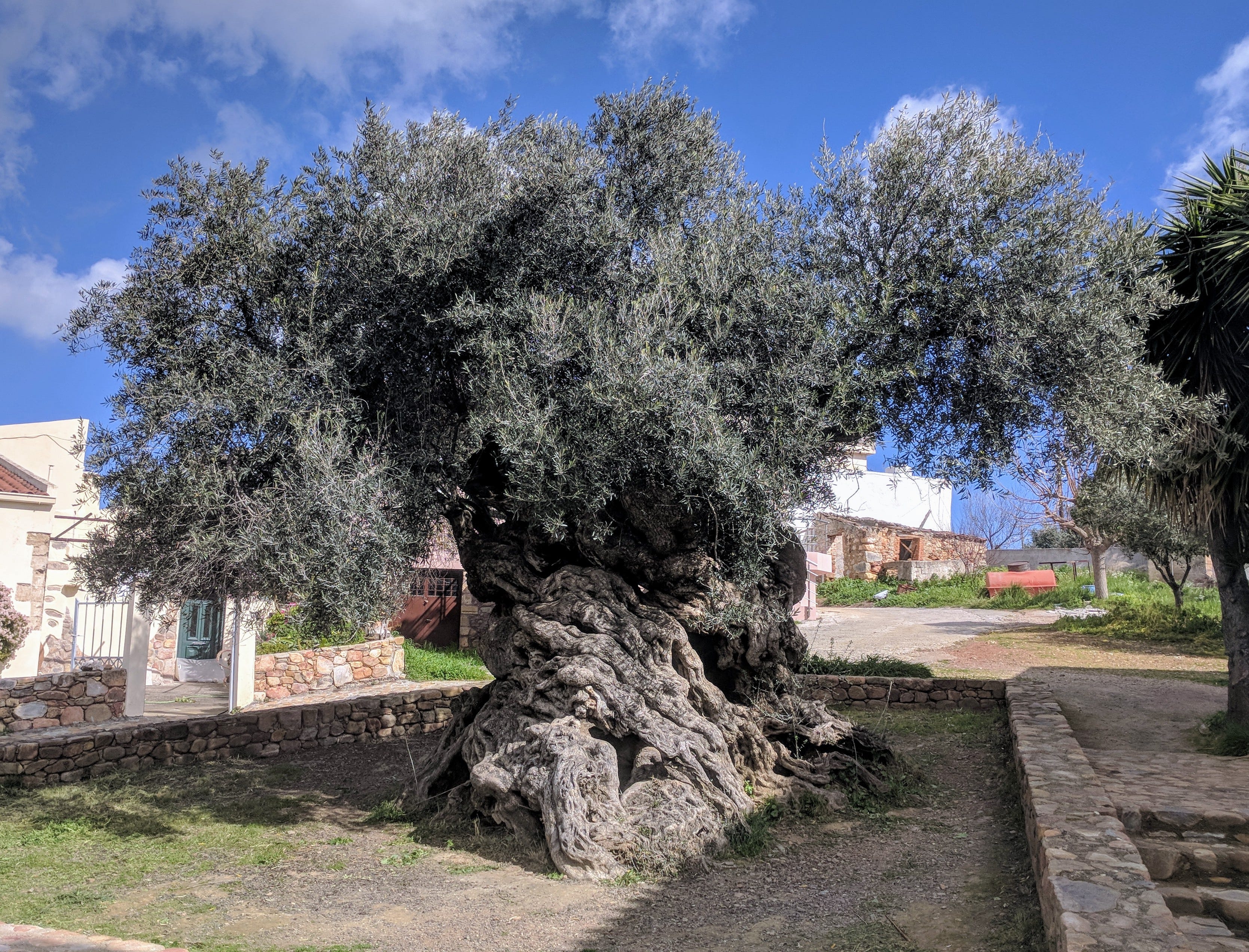
The olive tree, as much as the sea, is why Athens was rich, which is why they had the slack to invent so much of the modern world. Including social technologies, such as democracy.
Athena is the god of acting with intention. Poseidon creates a saltwater sea because that’s what he does. Athena creates a tree because she thinks it’ll be useful, not because she’s the god of trees or anything like that. Her gift is about the people.
At the time the myth was first being told, that sea still existed in the form of a sacred well, the Erechtheion, built into the Acropolis and maintained as a shrine by priests. But that kind of power doesn’t last. Culture shifted, and the well was allowed to run dry. The olive tree does not depend on any one cult, any one institution, any one ideology. It endures.
If you’re free to listen to songs at the moment, this is probably the right amount of context for the Dar Williams songs Write This Number Down and Olive Tree. The former she’s described as her “Athena-ish” song. The latter, is, well. I cried. I described this blog in 2024 as trying to be “Dar Williams, but Substack,” and Olive Tree exemplifies what I mean.
“I Am The Storm King Now”
Greek myth, mostly without realizing it, prophesies that Athena will overthrow Zeus.
Zeus, god of lightning, ruler over all, overthrew his father, who had overthrown his father. The Fates prophesied that if he had a son with the Goddess of Wisdom, Metis, that son would be the one to continue the cycle and overthrow Zeus. But their only child was Athena. A daughter, not a son, and so the prophecy did not apply.
But what does gender even mean for a god?
Athena, in this version of her origin story, first appears already fully grown and clad in armor from head to toe. She’s a shapeshifter—she takes whatever form, male or female, will be most useful in any given situation. Under these circumstances, with the prophecy being what it was, presenting as female was another kind of armor. But underneath that, what was Athena really? How could we know?3
For most of history, it would have been obvious that Zeus still reigned. No work of engineering could withstand all natural disasters. No means of organizing society could withstand people’s lust for power. Men ruled over women, because men were stronger. In time, cults of Zeus, in his aspect of the thunder god Yahweh, began to deny that Athena even existed, and those were the cults that spread.
I think Zeus still reigns today, but I think he’s weakening. Athena rises.
Consider (as one does) the story of Korean Air Lines Flight 007, which the Soviets shot down in 1983, killing among many others Larry McDonald, a prominent U.S. congressman. It’s clear what should’ve happened next, if we’d been in the world of the Iliad or the Book of Numbers. One superpower killed a leader of the other. This surely must trigger the long-delayed final confrontation, using the most powerful weapons they possess, until one side is crippled and the other annihilated.
And consider the life of Job, the good man who loses everything. Once, he says, the great and the good hung on his every word. Now, for no just reason he can see, he is an outcast. The King James Version has him phrase this in an interesting way: I am a brother to dragons, and a companion to owls. Athena created the constellation Draco, and her sacred animal is the owl. But it’s not Athena who replies to him. It’s a voice out of the whirlwind, proud, scornful, angry at being questioned. How can he think to judge the actions of God, when he has so little wisdom of his own?
Canst thou send lightnings, that they may go and say unto thee, Here we are? - Job: 38:35, KJV
The actual thing that happened in response to Flight 007 wasn’t a nuclear war. There was no vengeance, no purification. The Reagan administration responded by releasing what we now call GPS, the Global Positioning System, to everyone in the world. Before, the signals were encrypted, usable only by the U.S. military. But Flight 007 never would have gone so far off course, never been shot down, if it’d had GPS.
Today, we have placed 31 new moons in the lower heavens. They form a redundant network woven across the entire surface of the world. We send lightnings to them, and they return and tell us where we are.
This is the power of Athena. This is her revolution, and she’s counting on us to see it through.
It’s like we have returned to that hill
But there are more of us now, and the circle is widening still
In the back and the forth, it’s like we’re holding a trust
Like we know that we count, like something’s counting on us
And I hear all these voices rise up like an offering
We’re a part of it all, when no one promised us anything
And this is my world, it’s the air that I breathe
This most enlightened of groves, this most sacred of trees
Olive Tree, Dar Williams
I want to emphasize that I’m not trying to invoke any kind of legalistic gotcha in calling out this verse. We can and do find solid reasons why halacha doesn’t actually mean you gotta stone people to death. I’m just saying that if you opened up a random blog, and the first post you saw was the author saying “There should be a death penalty for making unproven rape allegations,” you would probably stop reading that blog.
There’s a lot to say about Moses’s Midianite wife, Zipporah, but she’ll have to wait for another post.
It’s possible Homer was thinking something like this. There’s a passing reference in the Iliad to a coup by Athena, Hera, and Poseidon that succeeded in binding Zeus until he was freed by the goddess Thetis. In that work, Athena mostly takes male form when walking among mortals.
I loved this. Sent it to Dar! Also my friend who has a granddaughter named Athena! She loved it, too!
Beautiful, Aaron.