


Get out of the way. That was the project of the early-20th-century Surrealism movement: take the artist, or at least the artist’s consciousness, out of the process of creating art. Done correctly, the artist is a spectator as their unconscious mind creates the work. And, at least for many of the surrealists, ideally the artist’s personal unconscious mind itself gets out of the way, letting through the collective unconscious of all of humanity.
The surrealists took a good run at it. They used various means to put themselves into trances allowing “automatic writing.” They injected randomness. They invented the Exquisite Corpse, where you build a story, or a painting, step by step, rotating among artists, with nobody able to see the whole work until it’s done. Some of them, such as Max Ernst, believed they had succeeded. But I agree with the Surreal Heretic Pierre Naville when he wrote in 1925 that “Everybody knows there is no such thing as a surrealist painting.” All art, if created with technique, is of the artist, and art with no technique is mere randomness. The surrealists created some great art, but they did not accomplish what they set out to do.
I don’t consider algorithmic art to be properly surreal, either. It can be profound, but it’s sounding the depths of mathematics, not humanity.
The output of a modern AI should not properly be considered algorithmic art (an LLM is created using algorithms but is not itself algorithmic). However, it is also not properly surreal, because today’s AI has been fine-tuned and prompted to imitate a person, and that pseudo-person is a visible participant in any attempt at surreal art. Even DALL-E, the explicitly surrealist art generator, feels a bit too sophisticated and distinctive.
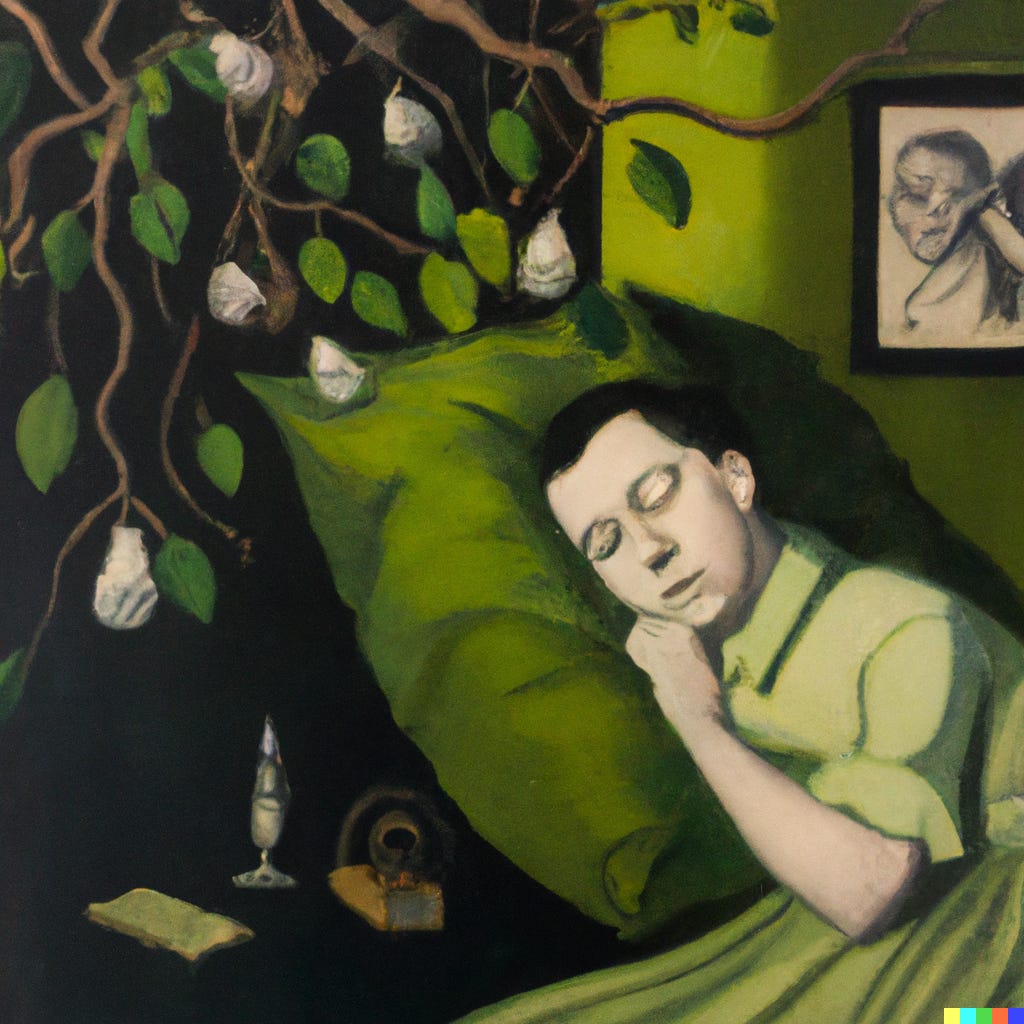
No, the only way to get true surrealist art is to go back seven or so years and use one of the early transformer models, such as GPT-2. GPT-2 is a pure vessel for whatever you train it on, devoid (we hope) of consciousness, but capable of channeling all of human culture that can be tokenized. Truly automatic writing. GPT-2’s output is both human and mindless, a combination that had never before been achieved.
Recently, I used this Google Colab to take a GPT-2-small model and briefly fine-tune it on English translations of stories by I. L. Peretz. The text recognition on my MacBook missed some spaces, runningwordstogether, and I declined to fix that. This was the first thing it output:
======== SAMPLE 1 ========
,theshammes, andtheneighborsofjustice
whomheavenlydothquestionedhisknowledge,
answeredwith: theworldhasa witness, the world is worthy
of the witness, and he, the witness, is prepared to answer.”
He paused, and the sadness in his voice brought with it
jolted home to him. “Listen to me!” he gasped. “Do
not speaka lie! I beg you, Father Elijah, keep silent! I beg you, Father
Elijah, do not distort the words! Listen carefully to what I have to say. I
must be clear; these are the words of the Song of Songs! Speak them
wildly and without voice, like true wolves, wild and pure! ...”
Ransom had to be made real now, genuine testimony, true
LHUHUH accurate voices! True voices!
I’d thought I might have to do more work to get something appropriate, but this was literally the first thing I tried. “Speak them wildly and without voice” is not me. It’s not Peretz. It’s not anyone.
It’s also not very interesting, in my opinion. I was fascinated by this kind of text when it first got to this level, but it suffers from redundancy: art should tell you something you don’t already know, and the collective unconscious (or whatever you call the thing GPT-2 channels) consists of stuff everybody knows. Wolves would be the perfect simile for “humans without civilization” except that they’ve been used that way for thousands of years, minimum. You could sort of fix that by turning up the “temperature” on the GPT-2 output, making it more random, but randomness without coherence is boring.
To get interesting, original writing, I think you need both creativity and a person. Or a reasonable facsimile thereof.