


In 1976, biomedical researcher Doris Anne Morgan made a world-changing discovery, and it couldn’t have come too soon. Dr. Morgan’s find would prove critical in isolating the first human retrovirus, in identifying HIV as the cause of AIDS, and in understanding the human immune system. This is all public knowledge.
And yet she has been given no major awards, no publicity. Outside of the work of science journalist Stephen S. Hall, she gets at most a couple sentences in histories of retrovirus research. I created and wrote her Wikipedia page in the course of researching this, so I’ve already told this story straight. Here, I’m going to try getting a bit more lyrical.
The Goddess and the Rooster
Doris Morgan was born in 1936 in Oceana, West Virginia. In a strange portent, all of these names mean “sea goddess.” The name Doris comes from Greek myth; Doris is a sea goddess or “Oceanid,” the daughter of the god Oceanus. Her name comes from a Greek word for “gift.” The last name Morgan comes from either a Welsh sea spirit or an Irish word meaning “of the sea.” West Virginia is landlocked, and there is no known explanation for it having a town named Oceana. (There are some legends, but no remotely plausible ones.)
Whenever a god takes mortal form, another soon arises to oppose her. Within a year, we see the birth of Robert Gallo in Waterbury, Connecticut. Robert comes from an ancient Germanic word meaning “famous,” while “Gallo” comes from the Latin for “rooster,” with the specific connotations of pride and vanity that lead to the word “cocky.” Waterbury, of course, is the land that sits near and absorbs the water, and Connecticut means the same thing in the Mohegan-Pequot language.
Their destinies were written. Doris Morgan would bring gifts from the sea, and Robert Gallo would claim the glory for himself.
Self-Sabotage
By 1974, Morgan had acquired a diverse skillset. She’d worked for years as a medical technologist in hematology, giving her practical experience in studying patients’ blood. Then, after a divorce, she’d gone back to school and earned a PhD in Biochemical Genetics, studying RNA activity in human bone marrow. She’d completed a three-year post-doc fellowship at the MD Anderson Cancer Center. She also had a fatal flaw: she was hopeless at telling a story. This was exactly the combination Robert Gallo needed desperately.
Gallo didn’t have quite so impressive a background. He had no PhD, no hematology experience. What he did have was a talent for manipulation and braggadocio, plus a decent scientific intuition. And also he was a man. So by 1974, he was running his own lab at the National Cancer Institute. He recruited Morgan, among other top talent, by promising them that they’d be joining the lab that was about to get a Nobel Prize. Gallo, you see, had discovered a mysterious substance that allowed him to culture leukemia cells, which nobody else was able to do. He didn’t know what it was, but it worked. He’d used it to discover evidence of a retrovirus, a virus that uses RNA rather than DNA, in a leukemia cell line he’d called HL-23 (the 23 may have just been because Gallo was born on the 23rd of March). So Gallo was on the verge of discovering the cause of one of the most common cancers. He’d already made the announcements, he just needed some help dotting the i’s and crossing the t’s.
When his new recruits arrived, they learned a different story. Gallo had discovered all of that, but then, over a long weekend, a mysterious saboteur had unplugged his refrigerator, turned up the heat on his incubator, and smashed his test tubes. The magical growth factor was gone, never to be rediscovered. The cell lines were unrecoverable.
Gallo said he thought he knew who had done it, but refused to say. I think I know too.
I’m not sure where the lies started. The timeline is messy. My best guess is that Gallo really believed that he’d found something, at first. Gallo had strong hunches that paid off frequently enough that he mistook them for facts. His lab, like most early virology labs, was sloppy. If you don’t fully understand how viruses spread, you don’t know which corners you can safely cut when isolating your samples from each other. His virus, HL-23V, turned out to be a mix of three animal viruses, and I think that was a genuine accident.
Then, I think he realized his mistake and hatched a plan to save face. Sabotaging his own lab, he delayed the reckoning long enough for him to be published in Nature, and then to use that prestige to hire people who could turn his lie into reality.
Fortunately for him, Doris Morgan had the magic touch.
Crossing the T-Cells
After speaking to Morgan and many of her lab partners, here’s how Stephen S. Hall described her gift:
Morgan had a feel for cells. There is no other way to put it. She was one of those people who lean over a microscope, peer down on what to less experienced or less patient eyes would appear as a monochromatic flatland cluttered with monotonous shapes, and see instead health or infirmity, growth or stasis, vigor or lassitude, life or death.
Her ability to tell, at a glance, whether a culture was thriving, meant that she could iterate through trial and error much faster than anyone else. After determining that it was impossible to “resurrect” whatever had been in Gallo’s refrigerator, she instead started trying various tweaks to the way cells were being cultured.
Gallo’s lab had been using gallons of specially-conditioned white blood cells in its experiments, then throwing them away as a by-product. At her last lab, Morgan had used a similar medium to keep her cell cultures alive longer. What if she kept improving on her techniques from then, using the free leftovers from the lab’s other experiments?
In March 1975, Morgan found…something. She was able to trigger “an incredible wave of exponential growth” in a sample of cancerous white blood cells. What, exactly, was growing, she couldn’t yet say, but it was the most interesting thing she, or anyone there, had found.
But Morgan was conflict-averse and bad at telling stories. She couldn’t persuade Gallo that this was worth exploring. Gallo was furious to learn that she’d been wasting her time on this nonsense instead of doing what he’d assigned her to do. He remembers screaming at her that her cells had “NO SIGNIFICANT INTEREST!!!”
Gallo wrote her off as a bad hire whom he’d fire at the next opportunity. In the meantime, unable to trust her with any real work, he let her keep plugging away. She’d present her results each week, and he’d listen silently and then move on.
Morgan wasn’t the only talented researcher who’d fallen for Gallo’s ruse, though. Other people on the team saw promise in her findings, and encouraged her to keep investigating, including by sending samples to other labs. And one, Frank Ruscetti, asked her if they could collaborate.
Together, they realized something incredible. Morgan’s mystery cell line was actually healthy T-cells. These were a part of the human immune system everybody knew was important, but nobody could study, because they couldn’t be grown in a lab. Until now.
The Sudden But Inevitable Betrayal
Morgan hadn’t found a way to directly stimulate cancer cells to grow. She’d found something better: a protein that stimulates the growth of T-cells, whether normal or cancerous. We now call it Interleukin-2. Gallo gradually realized that this could be helpful in his obsessive quest for human retroviruses. Fortunately, he didn’t realize that in time to stop Morgan from sharing the knowledge with his rivals.
Of course, he still added his name as co-author on Morgan and Ruscetti’s papers. This was now a Gallo Lab Discovery. But he couldn’t forgive their insubordination. Morgan remained frozen out of everything. She spent the next few months growing as many T-cells as she could and sending them to whoever wanted them. Then, she was abruptly fired.
Gallo didn’t immediately kick Ruscetti out with her, though. Ruscetti lead the effort to use Morgan’s discovery to finally find HTLV-1, the first deadly human retrovirus. Then Gallo fired him too.
Gallo clearly found it easier to dismiss Morgan’s abilities, and therefore Morgan. When he tells the story, he always knocks at least three years off of her experience level, making her his young apprentice rather than his peer. Sometimes, he claimed to have had the idea first and just assigned her to look into it. Later, he decided she had lucked into the discovery because she was ignorant and illogical, following a path he was smart enough to see wasn’t promising. “I think what I told her was logic,” he said. “The problem is, when you know things, sometimes it’s a problem. It’s a hindrance.”
There’s also a lot of overt sexism in Gallo’s narratives. When he eventually admitted that the “discovery would not have been made” without Morgan’s techniques, he didn’t call them techniques. Rather, he said, the key had been “the intensity, and the mothering and nurturing aspect, of a woman scientist.” So, basically, luck. “I do not know what it depended upon, a series of chance events, a woman who was willing to stay with cells, and some other fortuitous accidents.” In other interviews, he emphasized that she was “unmarried,” so these random cells were the only children she would ever have. I kind of thought I could go my whole life without briefly wanting to punch a 90-year-old cancer researcher in the face, but no.
And The Man Played On
We’ll get back to Morgan in a sec. The next phase of Gallo’s career is a bit more well known. Alan Alda played him as an utterly unlikable villain in the 1993 film And the Band Played On, based on a book by Randy Shilts. During the worldwide scramble to find the cause of AIDS, Gallo was convinced it would turn out to be a retrovirus (true) that was closely related to the one “he’d” already found (false). His focus was just a bit too narrow, and with the rebels fired his control over his lab was too absolute.
Fortunately for the continued survival of humanity, a lab in France soon adopted Doris Morgan’s technique. Françoise Barré-Sinoussi used Interleukin-2 to keep alive the T-cells in a blood sample from an AIDS patient, allowing the HIV virus in the blood to infect them and reproduce. With a large enough sample, the murderer could finally be unmasked.1
Before publishing their results, the French lab sent around samples to the other people working on the same thing. This included, of course, the Gallo lab. Gallo then proceeded to publish first, claimed the virus as his own, and denied that he’d ever received a sample from them.
Thanks in part to some investigative journalism from John Crewdson, the truth did eventually come out. DNA testing confirmed that the virus that the American team had was from the French sample. But, again, these early virology labs were sloppy about contamination. It was all too plausibly an innocent mistake, except for the lie Gallo told about never getting the French samples in the first place. Investigations couldn’t find definitive evidence that Gallo knowingly stole the virus.
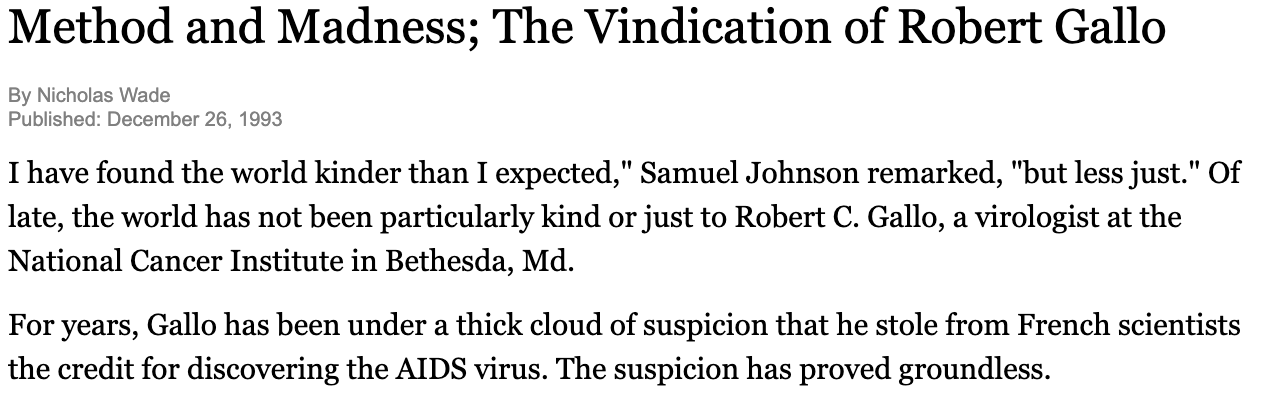
Gallo’s reputation took a hit, but he was too firmly entrenched as a Great Scientist for this to end his career. Many were happy to spin his acquittals as exonerations, rather than a case of “probably guilty with reasonable doubt.” THE VINDICATION OF ROBERT GALLO, ran a New York Times headline.
He did learn his lesson from the fiasco. Well, a lesson. Not a good one. From then on, whenever a researcher in his organization made a major find, Gallo insisted on being the first author listed on the paper. He and Ruscetti were both bummed that the first interleukin-2 paper had Doris Morgan’s name first.
He never got that Nobel. The Nobel Prize for the French team’s discovery of HIV was, controversially, only awarded to the French team. Many American scientists signed a letter of protest over Gallo’s exclusion. Sure, he hadn’t actually discovered HIV. But people thought he had for a while, and shouldn’t that have counted for something?
Return to the Sea
Doris Morgan was too humble to fight for public recognition. She just kept working—first in France, helping with the HIV work, and then for decades as a research professor at Drexel University back in the United States. In her office, where other scientists might display an award, a press clipping, or a diploma, Morgan displayed her letter of termination from Gallo’s lab.
She continued to develop and share new techniques for cell cultures, as well as cell cultures themselves. If you needed someone to get weird blood to grow in a lab, Dr. Morgan was the one to go to. As late as 2009, in her early seventies, Morgan appears as the primary author in papers on the structure of white blood cells in sea turtles.
After a career-defining discovery, scientists have the choice of several paths to immortality. For people like Gallo, one option is what economists call “rent-seeking:” position yourself as the gatekeeper for research, so that you can continue to get your name on papers without having to meaningfully contribute.
Luc Montagnier, the director of the French lab that discovered HIV, tried to branch out into other fields and make more world-changing discoveries, and turned into something of a crackpot. A classic case of Nobel disease.
Françoise Barré-Sinoussi stuck with her original mission: defeating AIDS, through research, advocacy, and organization. This triple role, plus the stress and horror of fighting a plague, nearly broke her. Only after the first treatments were developed, in 1996, did she allow herself to burn out. For a year. Then she dove back in.
Doris Morgan’s story is less dramatic. Her name lives on in the acknowledgement sections of other scientists who used her cell cultures, and her original interleukin-2 paper writes her name in ink in the history of medicine. But she mainly enjoys the quiet legacy of any successful scientist, embodied in the people she mentored and recorded in the work that builds on hers. Her discovery is part of the foundation of decades of life-saving work, work that has reduced deaths from leukemia by 70%, work that is stopping the spread of AIDS. Interleukin-2 itself, it turns out, can be a life-saving therapy. Archaeologists use her sea turtle papers to distinguish between human and marine animal blood on ancient Polynesian artifacts. The wave doesn’t die; it becomes the ocean.
I’m grateful to all of these people. Even Gallo probably helped, on net, because Morgan would have struggled to get funding and attention on her own. It’s pretty hard not to leave a positive legacy these days, whether or not anyone remembers your name.
Still. Let’s remember hers. Doris Anne Morgan, daughter of Oceana, who was tricked into taking on an impossible task, and accomplished it anyway. Her talent, skill, and dedication accelerated all AIDS research timelines by at least a year; an incalculable benefit of all of humanity. She deserves much more than this brief tribute, but this is what I have to give.
The And the Band Played On movie depicts this discovery being made by her director, Luc Montagnier, while she watches wide-eyed and silent. This isn’t the book’s fault, but it is ahistorical. Montagnier had helped get the lab started and was in a senior, administrative role. He was the face of the lab, and the discovery, but I don’t think he ever tried to steal Barré-Sinoussi’s credit.